Wrong.Run away now little turd. Go back to the kiddie table where you belong.
Mikey runs away a lot when caught or challenged.

Wrong.
The point is that we know it won't snow in Honolulu a year from now or be 100° in the northeast this Christmas because we know what the climate of both areas is like.
Wrong. That particular data is derived from a conglomeration of geological boreholes, you dickless lazy fuck. Hit the books.
Climate science is in it's infancy. They don't even know how clouds impact the climate. You are way out of your league here, son. Hit the books.
What are climate models missing?
Posted by curryja
by Judith Curry
Rather than reducing biases stemming from an inadequate representation of basic processes, additional complexity has multiplied the ways in which these biases introduce uncertainties in climate simulations. – Bjorn Stevens and Sandrine Bony
Science has published an interesting opinion piece by Bjorn Stevens and Sandrine Bony entitled What Are Climate Models Missing? [link] to abstract (paywalled). Here are some excerpts:
General Circulation Models [GCMs have gradually morphed into Global Climate Models, and with the more recent incorporation of models of the biosphere and the associated cycles of important chemical nutrients, Earth System Models.
The increase in complexity has greatly expanded the scope of questions to which General Circulation Models (GCMs) can be applied. Yet, it has had relatively little impact on key uncertainties that emerged in early studies with less comprehensive models. These uncertainties include the equilibrium climate sensitivity (that is, the global warming associated with a doubling of atmospheric carbon dioxide), arctic amplification of temperature changes, and regional precipitation responses. Rather than reducing biases stemming from an inadequate representation of basic processes, additional complexity has multiplied the ways in which these biases introduce uncertainties in climate simulations.
For instance, a poor understanding of what controls the distribution of tropical precipitation over land, and hence vegetation dynamics, limits attempts to understand the carbon cycle. Similarly, uncertainties in arctic amplification of warming hinder predictions of permafrost melting and resultant changes in soil biogeochemistry.
Although the drive to complexity has not reduced key uncertainties, it has addressed Smagorinsky’s question as to what level of process detail is necessary to understand the general circulation. There is now ample evidence that an inadequate representation of clouds and moist convection, or more generally the coupling between atmospheric water and circulation, is the main limitation in current representations of the climate system.
That this limitation constitutes a major roadblock to progress in climate science can be illustrated by simple numerical experiments.
In idealized simulations of a waterworld that neglect complex interactions among land surface, cryosphere, biosphere, and aerosol and chemical processes (see the figure), the key uncertainties associated with the response of clouds and precipitation to global warming are as large as they are in comprehensive Earth System Models.
Differences among the simulations in the figure are especially evident in the tropics, where the sign of cloud changes and the spatial structure of the precipitation response differ fundamentally between models. This diversity of responses arises because, at low latitudes, the coupling between water and circulation is disproportionately dependent on the representation of unresolved processes, such as moist convection and cloud formation. The mid-latitudes show more robust responses because much of the energy transport is carried by baroclinic eddies; these, too, are fundamentally coupled to water, but they are much better described and resolved by modern GCMs, as foreseen by Smagorinsky.
The uncertain interplay between water and circulation that underlies differences in the response of the climate system to warming can be expressed in terms of more specific questions. For instance, how do marine boundary-layer clouds depend on their environment? Or how do atmospheric circulations couple to moist convection through surface and radiative fluxes? The first question ends up being key to explaining the intermodel spread in climate sensitivity, the second to the pattern of the regional response to warming. Differences in regional responses also influence ocean circulations, and hence how oceans take up heat, as well as patterns of precipitation, and hence how the land biosphere takes up carbon.
A deeper understanding and better representation of the coupling between water and circulation, rather than a more expansive representation of the Earth System, is thus necessary to reduce the uncertainty in estimates of the climate sensitivity and to guide adaptation to climate change at the regional level.
JC comments: Stevens and Bony make the important point that adding complexity to Earth Systems Models (e.g. carbon cycle, atmospheric chemistry, more complex land surface processes) doesn’t help improve the fundamental deficiencies of climate models.
Stevens and Bony focus on clouds, which is their area of expertise. Clouds are arguably the greatest reason for disagreement among climate models. However, IMO the more fundamental problems with climate models lie in the coupling of two chaotic fluids – the ocean and the atmosphere. The inability of climate models to simulate the evolution of and connections among the teleconnections and interannual to multidecadal circulation regimes is the biggest source of problems for understanding regional climate variability.
Taking climate modeling back to basics to address the interplay between atmospheric water and the atmospheric circulation, and the complex couplings between the atmosphere and ocean, require going back to basics and looking at a hierarchy of models and a range of model structural forms. Better understanding and simulation of the climate requires that improve our understanding and treatment of these processes in climate models. It is pointless to worry about aerosols, carbon cycle etc in the context of climate models until these more fundamental issues are addressed.

No, the GND is not a slogan like the Hopey Changey thing. It is an actual House resolution that failed in the Senate 0-57 with most senate Dems voting present, for fucks sake.

So my point of the comment was to say Biden should call it BIDEN's NEW DEAL
I'm sure his climate czar AOC will be surprised to hear that! 
You don't even know what climate is.
You're talking out your ass, Pendejo.
Penn. has had sunny and warm Christmases. Hawaii had 6 inches of snow in 1938.
And you're the asshole that's going to tell me what the weather will be in these places a 100 years from now?
Weather is what happens in a particular region in the short term. Climate is weather patterns of a particular region over long periods of time.
Define 'long period of time'. Define 'short term'. Define 'weather pattern'. Buzzword fallacies.
The point is that we know it won't snow in Honolulu a year from now or be 100° in the northeast this Christmas because we know what the climate of both areas is like.
Hawaii gets snow every year. They even have a ski area. You can go skiing and swimming all in the same day in Hawaii during the winter.
The waters around Hawaii are a marine tropical climate. There is no value that 'changes'.
Climate has no value that changes. It has no value. Subjective descriptions have no quantitative value.
You're the loser who thinks he is in a position to lecture biologists on evolution, geologists on the age of the planet, climate scientists on climate, virologists on viruses, and honest Americans on truth.
Lol.
So, Mikey, you are the expert on all of these disciplines.
it's a common practice throughout American history
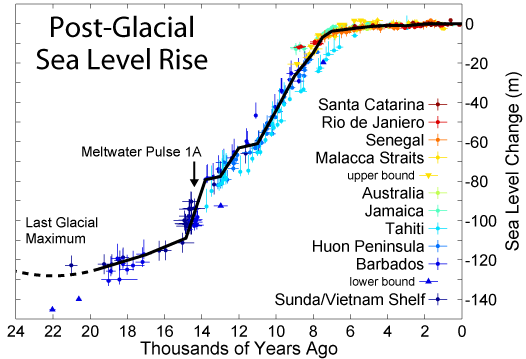
Do you understand that this chart shows that sea level rose at a rate of 4 ft. per century for 10,000 years? Or is it too sciency for you.
Where did I mention AGW or climate change?
Correct - I didn't mention AGW.
Thanks for playing.
Changing our relationship w/ the planet and creating a more sustainable future for all of mankind.
Man can I have some of what you're smoking?

When you don't cut & paste, you usually don't have very constructive or informative comments.
Of course I'm not, and that's the point. Neither of us is, and it is the ultimate sign of arrogance to not defer to someone who knows more than you do about something.
If ten medical doctors independently diagnose you with the same disease and all recommend the same or similar treatments, why would you ignore them?