So, You Want $15 An Hour?

The problem with a universal minimum wage in a nation like the US is that the cost of living, availability of labor, and profitability of businesses is not a constant across the entire nation. Thus, in a large city, in a blue state, on one of the coasts, $15 an hour might not be sufficient to meet someone's basic needs, while that same wage in the middle of Kansas in a tiny town would be completely unaffordable to both the local businesses and their customers as it would greatly exceed the cost of living there.

One-size-fits-all diktat from on high by the federal government is rarely a good solution to anything.
 
The problem with a universal minimum wage in a nation like the US is that the cost of living, availability of labor, and profitability of businesses is not a constant across the entire nation. Thus, in a large city, in a blue state, on one of the coasts, $15 an hour might not be sufficient to meet someone's basic needs, while that same wage in the middle of Kansas in a tiny town would be completely unaffordable to both the local businesses and their customers as it would greatly exceed the cost of living there.

One-size-fits-all diktat from on high by the federal government is rarely a good solution to anything.

Ahh, but the problem is that the scenario of a $15 minimum wage is going to bankrupt small town USA is a misnomer, because if $15/hr "exceeds the (local) cost of living, then we're talking poverty line existence FOR ALL, and that would require gov't assistance just to keep from becoming a ghost town without a raise.

And then there's this:

How to respond to the 5 most tired, trickle-down arguments against the $15 minimum wage

https://www.businessinsider.com/debunking-common-arguments-against-15-minimum-wage-2021-2
 
The problem with a universal minimum wage in a nation like the US is that the cost of living, availability of labor, and profitability of businesses is not a constant across the entire nation. Thus, in a large city, in a blue state, on one of the coasts, $15 an hour might not be sufficient to meet someone's basic needs, while that same wage in the middle of Kansas in a tiny town would be completely unaffordable to both the local businesses and their customers as it would greatly exceed the cost of living there.

One-size-fits-all diktat from on high by the federal government is rarely a good solution to anything.

Ahh, but the problem is that the scenario of a $15 minimum wage is going to bankrupt small town USA is a misnomer, because if $15/hr "exceeds the (local) cost of living, then we're talking poverty line existence FOR ALL, and that would require gov't assistance just to keep from becoming a ghost town without a raise.

And then there's this:

How to respond to the 5 most tired, trickle-down arguments against the $15 minimum wage

https://www.businessinsider.com/debunking-common-arguments-against-15-minimum-wage-2021-2


The Counterintuitive Workings of the Minimum Wage


Even in low-wage, low-density, low-cost-of-living parts of the country, a $15 minimum might not be a death knell for small businesses or a job killer for low-wage workers.


https://www.theatlantic.com/ideas/archive/2021/01/counterintuitive-workings-minimum-wage/617861/
 
Lots of companies making huge profits do not rely on highly skilled labor. The average fast-food worker is over 24. They are not just kids. If those workers do not show up for work, the company makes nothing. They should treat them as valuable parts of their business.
Removing labor from the, bottom, helps with market based metrics for capitalists. Compensation for capitalism's natural rate of unemployment means only motivated and skilled labor would pursue jobs which their skills can command.
 
Your first sentence was disproven via our exchanges. You stubbornly insist to the point of insipidness on your personal opinions and interpretations substituting historically valid and documented facts and precedents. The reason people are fighting for a $15/hr minimum wage is exercising those protections brought about the people pushing their gov't reps to change the law. PEOPLE change/make laws and thus create government....NOT vice versa. That you refuse to accept this reality is of no consequence.
You are missing the point. Hypothetically, our legislators can fix the Standard for compensation for capitalism's natural rate of State unemployment at fourteen dollars an hour. Any resulting market based wage would be more freely arbitrated by those labor market participants presumably more motivated and more skilled.
 
Ahh, but the problem is that the scenario of a $15 minimum wage is going to bankrupt small town USA is a misnomer, because if $15/hr "exceeds the (local) cost of living, then we're talking poverty line existence FOR ALL, and that would require gov't assistance just to keep from becoming a ghost town without a raise.

And then there's this:

How to respond to the 5 most tired, trickle-down arguments against the $15 minimum wage

https://www.businessinsider.com/debunking-common-arguments-against-15-minimum-wage-2021-2

The Business Insider article--which I read, along with the embedded links--doesn't address my argument. For example, the small-town argument they make is based on a Princeton study was based on 138 cases in the states of California, Illinois, Massachusetts, New Jersey, and New York where a $15 minimum wage was adopted.
https://academic.oup.com/qje/article/134/3/1405/5484905?login=false

That doesn't address in the least a comprehensive, nationwide adoption of such a wage and its effects on states that have currently a much lower minimum wage, unlike the states cited in the study where the wage was raised because it was already being reached by employers simply due to the cost of living there. That is, the study looked at examples where $15 was the market demand even as the official minimum wage set by government was much lower.

The other four responses the BI article gives don't apply at all to the example I gave.
 
The Business Insider article--which I read, along with the embedded links--doesn't address my argument. For example, the small-town argument they make is based on a Princeton study was based on 138 cases in the states of California, Illinois, Massachusetts, New Jersey, and New York where a $15 minimum wage was adopted.
https://academic.oup.com/qje/article/134/3/1405/5484905?login=false

That doesn't address in the least a comprehensive, nationwide adoption of such a wage and its effects on states that have currently a much lower minimum wage, unlike the states cited in the study where the wage was raised because it was already being reached by employers simply due to the cost of living there. That is, the study looked at examples where $15 was the market demand even as the official minimum wage set by government was much lower.

The other four responses the BI article gives don't apply at all to the example I gave.
Let's assume any firms raising the minimum wage can get a tax break.
 
Let's assume any firms raising the minimum wage can get a tax break.

Doesn't help in the short-term at all. For example, if the minimum goes up to $15 per hour employer contributions to all sorts of non-taxable things the government forces payment into--like social security, unemployment insurance, and the like--will go up with the wage. On average, right now, employers are paying

NAM-CostofRegulations-PerEmployeeBurden-1998x999.png


https://www.nam.org/the-cost-of-fed...latory costs of $34,671 per employee per year.

exceeds $10,000 per year (shown is for manufacturing) on its own. This will increase as wages increase because many of those costs are associated with the wage paid. For employers currently paying as little as two-thirds of that wage, possibly less, this is a huge hit that a tax break won't fix. Something has to change for them, and that will be a big increase in their prices most likely. Worse, this part of the problem favors the biggest employers the most. It hurts the small business employer the most.
 
Quote Originally Posted by Taichiliberal View Post
Your first sentence was disproven via our exchanges. You stubbornly insist to the point of insipidness on your personal opinions and interpretations substituting historically valid and documented facts and precedents. The reason people are fighting for a $15/hr minimum wage is exercising those protections brought about the people pushing their gov't reps to change the law. PEOPLE change/make laws and thus create government....NOT vice versa. That you refuse to accept this reality is of no consequence.

You are missing the point. Hypothetically, our legislators can fix the Standard for compensation for capitalism's natural rate of State unemployment at fourteen dollars an hour. Any resulting market based wage would be more freely arbitrated by those labor market participants presumably more motivated and more skilled.

1. YOU insist upon treating your "hypotheticals" as a reasonably fact based declarations. As I've pointed out in our exchanges, that dog of yours won't fly. FYI, our legislators have the legal ability courtesy of the Constitution to change our national financial actions....they usually do this through the lobbying of various financial institutions or through the pressure/power of the people (i.e., the U.S. Labor Movement). And FYI, there is no "free market";

https://www.theguardian.com/commentisfree/2020/dec/09/inequality-free-market-myth-billionaires
 
The Business Insider article--which I read, along with the embedded links--doesn't address my argument. For example, the small-town argument they make is based on a Princeton study was based on 138 cases in the states of California, Illinois, Massachusetts, New Jersey, and New York where a $15 minimum wage was adopted.
https://academic.oup.com/qje/article/134/3/1405/5484905?login=false

That doesn't address in the least a comprehensive, nationwide adoption of such a wage and its effects on states that have currently a much lower minimum wage, unlike the states cited in the study where the wage was raised because it was already being reached by employers simply due to the cost of living there. That is, the study looked at examples where $15 was the market demand even as the official minimum wage set by government was much lower.

The other four responses the BI article gives don't apply at all to the example I gave.

Once again, you ignore what you don't like in favor of supposition and conjecture. Sorry, but that dog of yours won't fly. Observe a synopsis that counters your narrative:


The Business Insider article--which I read, along with the embedded links--doesn't address my argument. For example, the small-town argument they make is based on a Princeton study was based on 138 cases in the states of California, Illinois, Massachusetts, New Jersey, and New York where a $15 minimum wage was adopted.
https://academic.oup.com/qje/article/134/3/1405/5484905?login=false

That doesn't address in the least a comprehensive, nationwide adoption of such a wage and its effects on states that have currently a much lower minimum wage, unlike the states cited in the study where the wage was raised because it was already being reached by employers simply due to the cost of living there. That is, the study looked at examples where $15 was the market demand even as the official minimum wage set by government was much lower.

The other four responses the BI article gives don't apply at all to the example I gave.

Agreed, but it doesn't take a college degree to figure out that the adequacy of one's wagers is determined by the costs of the local economy. In short, in NY, $15 isn't enough and in most of Texas it's too much. IMO, it should be a state thing. The propensity for Democratic Party Federalism and their "One Size Fits All" legislation is wrong.

If they want to pass a universal minimum wage, they'd be smarter to index it to the local economy, not a flat fucking rate for everyone. They don't like a flat rate for taxes, but they do favor telling others how to spend their money.
 
Doesn't help in the short-term at all. For example, if the minimum goes up to $15 per hour employer contributions to all sorts of non-taxable things the government forces payment into--like social security, unemployment insurance, and the like--will go up with the wage. On average, right now, employers are paying

NAM-CostofRegulations-PerEmployeeBurden-1998x999.png


https://www.nam.org/the-cost-of-fed...latory costs of $34,671 per employee per year.

exceeds $10,000 per year (shown is for manufacturing) on its own. This will increase as wages increase because many of those costs are associated with the wage paid. For employers currently paying as little as two-thirds of that wage, possibly less, this is a huge hit that a tax break won't fix. Something has to change for them, and that will be a big increase in their prices most likely. Worse, this part of the problem favors the biggest employers the most. It hurts the small business employer the most.

And now, another view:


Minimum wage increases aren’t a job killer: Small business survey


Just 8% of small business owners say they will be forced to lay off workers as a result of the higher minimum wage, while 14% say they will be forced to cut worker hours, 14% say the higher minimum wage will result in less revenue for their business and 22% say it will result in less profit for them.

https://www.cnbc.com/2020/02/20/minimum-wage-increases-arent-a-job-killer-small-business-survey.html
 
And now, another view:


Minimum wage increases aren’t a job killer: Small business survey


Just 8% of small business owners say they will be forced to lay off workers as a result of the higher minimum wage, while 14% say they will be forced to cut worker hours, 14% say the higher minimum wage will result in less revenue for their business and 22% say it will result in less profit for them.

https://www.cnbc.com/2020/02/20/minimum-wage-increases-arent-a-job-killer-small-business-survey.html

That is nothing but a logical fallacy, affirming the consequent. By that, it argues that state increases in minimum wage--BY STATE--will somehow have the exact same effect as a massive increase in minimum wage mandated by the federal government. To be a bit more specific, take Arizona my state. The minimum wage is indexed to inflation and the cost of living index. As these rise, the state minimum wage rises and it's now a bit over $12 an hour. Employers handle the incremental increase on a yearly basis.

But, a sudden nationwide increase in the manditory minimum to $15 an hour is different.

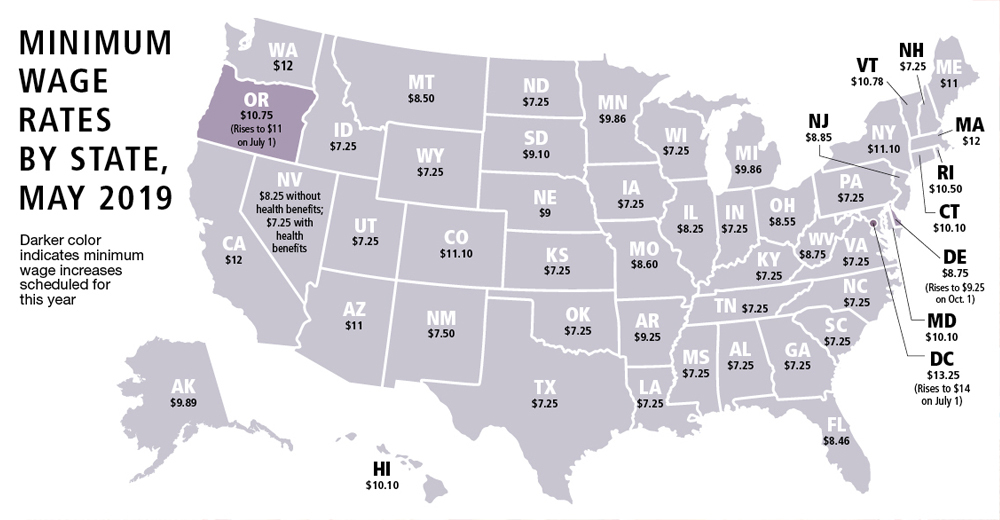
Wages_1_map.jpg


Yes, that is 2019 but it's just as relevant. Take a state like Kansas. To suddenly raise the minimum wage there by nearly $7 an hour, virtually doubling wages overnight, would be crippling. We have no data for what happens when something like that is done. Or, in Nevada where minimum wage is often coupled to service jobs that rely on heavy tipping and can often exceed $15 an hour when that's accounted for. Same thing. Double the wage and watch people become far more reluctant to provide a big tip. That upsets the current dynamic in a major way.
 
1) I'm not against mw going up, it's just a matter of how much and for whom. I don't think teenagers need to earn $15 an hour to screw up my order at Burger King.

And I don't think Jeff Bezos needs US$100 billion while fucking over his workers.

So because they are free to decline offers they feel are too low and go somewhere else.

And when the working man does this, people call him "ungrateful," and "lazy," and "not wanting to work."
 
The problem with a universal minimum wage in a nation like the US is that the cost of living, availability of labor, and profitability of businesses is not a constant across the entire nation. Thus, in a large city, in a blue state, on one of the coasts, $15 an hour might not be sufficient to meet someone's basic needs, while that same wage in the middle of Kansas in a tiny town would be completely unaffordable to both the local businesses and their customers as it would greatly exceed the cost of living there.

One-size-fits-all diktat from on high by the federal government is rarely a good solution to anything.
It's simpler than that. It is manipulation of markets. It is fascism. Price controls never work. They always cause shortages.
 
Ahh, but the problem is that the scenario of a $15 minimum wage is going to bankrupt small town USA is a misnomer, because if $15/hr "exceeds the (local) cost of living, then we're talking poverty line existence FOR ALL, and that would require gov't assistance just to keep from becoming a ghost town without a raise.

And then there's this:

How to respond to the 5 most tired, trickle-down arguments against the $15 minimum wage

https://www.businessinsider.com/debunking-common-arguments-against-15-minimum-wage-2021-2

Still trying to push fascism, ain't ya?
Price controls do not work. They always produce shortages.
 
Removing labor from the, bottom, helps with market based metrics for capitalists. Compensation for capitalism's natural rate of unemployment means only motivated and skilled labor would pursue jobs which their skills can command.

Capitalism has no unemployment. Anyone can play that wants to.
 
You are missing the point.
No, that would be YOU.
Hypothetically, our legislators can fix the Standard for compensation
Communism doesn't work. It is theft.
for capitalism's natural rate of State unemployment
Capitalism has no unemployment. Anyone that wants to produce can do so. Anyone can play.
at fourteen dollars an hour.
Random number.
Any resulting market based wage would be more freely arbitrated by those labor market participants presumably more motivated and more skilled.
Price controls are not free arbitration.
 
The Business Insider article--which I read, along with the embedded links--doesn't address my argument. For example, the small-town argument they make is based on a Princeton study was based on 138 cases in the states of California, Illinois, Massachusetts, New Jersey, and New York where a $15 minimum wage was adopted.
https://academic.oup.com/qje/article/134/3/1405/5484905?login=false

That doesn't address in the least a comprehensive, nationwide adoption of such a wage and its effects on states that have currently a much lower minimum wage, unlike the states cited in the study where the wage was raised because it was already being reached by employers simply due to the cost of living there. That is, the study looked at examples where $15 was the market demand even as the official minimum wage set by government was much lower.

The other four responses the BI article gives don't apply at all to the example I gave.

Studies are not economy.
Price controls do not work. It is fascism. They always cause shortages.
 
Back
Top