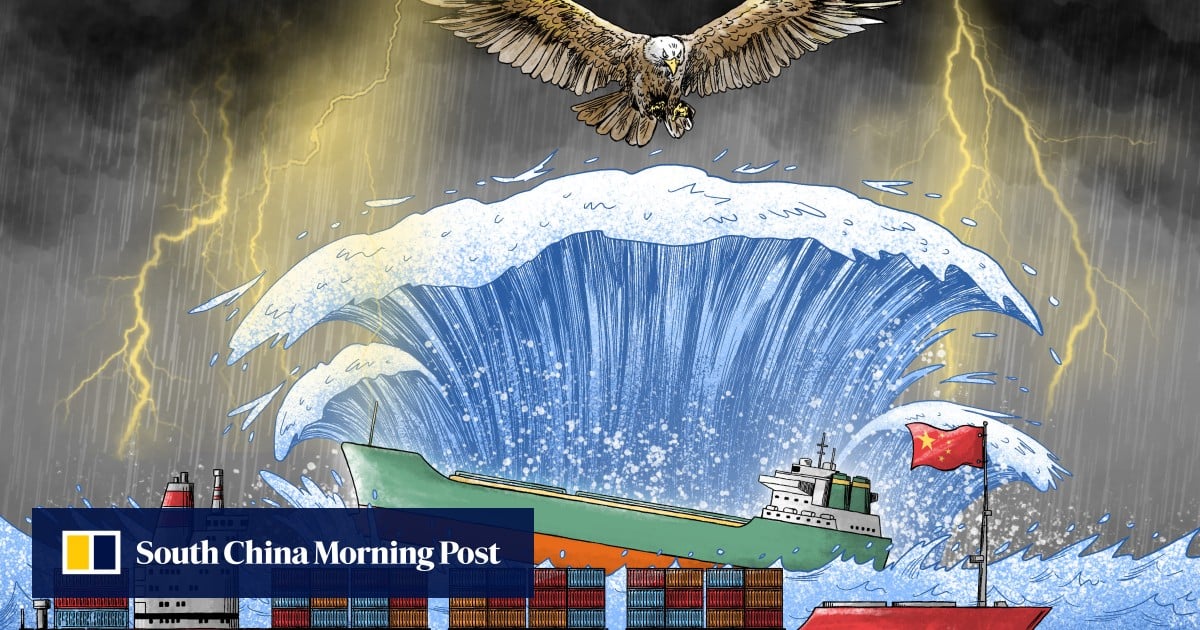
War with China

Mahmoud Ahmadinejad

الله أكبر)
At the least, it is thought likely that America will face strong diplomatic condemnation from China, economic retaliation, heightened risk of a naval standoff or incident at sea possibly an immediate full-scale war,

This scenario is not purely hypothetical; it aligns closely with President Trump's April 12, 2026, order for the US Navy to blockade the waters of the Strait of Hormuz and interdict any vessels that paid Iran a fee for access to the northern shipping channel through the Strait of Hormuz.

China has signaled it may deploy People's Liberation Army Navy (PLAN) escorts as "safeguards" for its merchant fleet.

Under international law (primarily UNCLOS), flag states have primary jurisdiction over their vessels on the high seas. Unilateral interdiction of neutral Chinese-flagged ships without UN Security Council authorization, consent, or clear self-defense grounds is widely viewed as a violation of flag-state sovereignty—potentially an "act of war" in legal terms.

American interdictions would spike prices, fuel inflation, and disrupt Asian economies (China, India, and Japan remain heavily reliant on Gulf oil ).

The real danger is miscalculation during an interdiction operation. This fits Trump's "maximum pressure" style but carries classic great-power escalation risks.
 
Naval boarding has historically been a significant tactic that contributed to armed conflicts.
In 1731 a Spanish boarding of the British merchant ship Rebecca allegedly led to Captain Robert Jenkins’s ear being cut off; Jenkins later presented his ear to the British Parliament in 1738, which helped fuel public outrage. Outcome: Britain declared war on Spain in 1739.

The First Barbary War (1801–1805) began because North African Barbary states (especially Tripoli) were extorting tribute from American merchant ships; when the Pasha of Tripoli demanded higher payments and the U.S. (under President Jefferson) refused, Tripoli declared war in 1801 and began seizing U.S. vessels and crews, prompting a U.S. naval response.

The War of 1812 has likewise been attributed to the English Royal Navy's own practice of stopping American vessels to where boarding actions were common.
  • The Little Belt affair (May 1811): also impelled the United states toward war with England. A violent encounter between USS President and HMS Little Belt heightened tensions.
  • HMS Leopard pursued, fired on, boarded and seized sailors from USS Chesapeake off Norfolk; a high‑profile outrage that fueled U.S. public anger.
  • Widespread Royal Navy searches/boardings and impressment (c. 1805–1812): Repeated stops of American merchant and naval vessels to search for deserters and forcibly take (or “impress”) sailors. The cumulative pattern was a principal grievance.
 
The China Escalation Risk


The Trump-ordered blockade creates a high-stakes standoff with Beijing for several reasons.

The U.S. Navy has been ordered to "seek and interdict" any vessel in international waters that has paid a "transit toll" to Iran.
  • Energy Security: China is Iran's largest oil customer, purchasing roughly 80% of Iran's oil exports in 2025. Blocking these shipments directly threatens China's energy supply.
  • Direct Confrontation: Analysts warn that if China sends its own warships to escort tankers through the blockade, the U.S. Navy would face a choice: let them pass or risk a direct military clash with a peer power.
  • Economic Retaliation: Trump has already threatened to impose a 50% tariff on all Chinese imports if Beijing attempts to assist Iran's military.
    • Global Oil Shock: The Strait of Hormuz handles approximately 20% of the world's seaborne oil. Markets have already seen oil prices surge 30% above pre-war levels, with some cargoes exceeding $140 per barrel.
    • Iranian Retaliation: Iran has warned that any interference with its exports will be met with a "harsh response," potentially using drones, missiles, and remaining naval assets to target U.S. forces.
    • Military Readiness: The USS Gerald R. Ford carrier strike group is currently positioned in the Persian Gulf. That's quite a target.
 
At the least, it is thought likely that America will face strong diplomatic condemnation from China, economic retaliation, heightened risk of a naval standoff or incident at sea possibly an immediate full-scale war,

This scenario is not purely hypothetical; it aligns closely with President Trump's April 12, 2026, order for the US Navy to blockade the waters of the Strait of Hormuz and interdict any vessels that paid Iran a fee for access to the northern shipping channel through the Strait of Hormuz.

China has signaled it may deploy People's Liberation Army Navy (PLAN) escorts as "safeguards" for its merchant fleet.

Under international law (primarily UNCLOS), flag states have primary jurisdiction over their vessels on the high seas. Unilateral interdiction of neutral Chinese-flagged ships without UN Security Council authorization, consent, or clear self-defense grounds is widely viewed as a violation of flag-state sovereignty—potentially an "act of war" in legal terms.

American interdictions would spike prices, fuel inflation, and disrupt Asian economies (China, India, and Japan remain heavily reliant on Gulf oil ).

The real danger is miscalculation during an interdiction operation. This fits Trump's "maximum pressure" style but carries classic great-power escalation risks.

View: https://www.instagram.com/reel/DW-fTo6jdtx/?igsh=enk0aWtwanU0djl0
 
Chinas army can equal the US army. But the navy and airforce are far behind

China’s People’s Liberation Army Navy (PLAN) is numerically the world's largest. China's newest carrier, the Fujian, utilizes advanced electromagnetic launch systems.

China's massive inventory of land-based anti-ship and anti-air missiles can threaten U.S. carriers and bases from thousands of miles away.

China’s manufacturing capacity for ships and missiles is significantly higher than that of the US, allowing them to replace losses much faster in a high-intensity, long-term conflict. China's shipbuilding capacity is estimated to be over 200 times that of the U.S., meaning they can replace combat losses much faster in a prolonged war.

The U.S. has a massive inventory of 5th-generation F-22s and F-35s. China’s J-20 is considered a peer competitor, and its production rate has surged to an estimated 100+ units annually.


The Iranian government enforces the laws of the Islamic Republic.

Rioters, spies, and agitators are severely dealt with according to the Constitution.
  • Article 27: The Constitution states that "unarmed assemblies and marches may be freely organized, provided that no violation of the foundations of Islam is involved".
  • Permit System: Gathering legally requires a permit.
  • The Islamic Penal Code and other laws are used to prosecute participants in unauthorized protests.
  • Propaganda against the state: Protesters can be charged with "propaganda against the state".
  • "Sowing Corruption on Earth" (Mofsed-e-fel-Arz): A capital penalty is applied to protesters deemed to be acting against their government.
  • Waging War against God (Moharebeh): This is applied to protesters, particularly if they are accused of using weapons, and is punishable by death.
  • Disrupting Public Order: Criminalized acts are punishable by prison and lashes (corporal punishment).
  • Anti-regime Activities: Activities undermining the fundamental principles of Islam or the basis of the Islamic republic are prohibited and violators are subject to arrest and prosecution.

As the Americans say, if you can't do the time, don't do the crime.
 
我国的战略规划是:到2035年基本实现国防和军队现代化;到本世纪中叶把人民军队全面建成世界一流军队。
Translation:
The strategic plan of our country is: to achieve the basic modernization of national defense and the armed forces by 2035; and to comprehensively build the people's military into a world-class military by the mid-21st century.
 
Moreover, I am of the view that no military conflict will take place between China and the United States during the Trump presidency. Remember what I say, for this is absolutely certain.
 
Back
Top