
You are using an out of date browser. It may not display this or other websites correctly.
You should upgrade or use an alternative browser.
You should upgrade or use an alternative browser.
Recommend Political Books You Think Everybody Should Read Here
- Thread starter Damocles
- Start date


Wow. If there was a ugly and hateful trolling, that post would be it.


Unlike Aldous Huxley’s Brave New World and George Orwell’s 1984, Jean Raspail’s The Camp of the Saints lacks any aura of respectability.
In the United States, it is attacked as a bigoted screed, “a must-read within white supremacist circles.”
Raspail, who won some of France’s most important literary prizes, is regarded as an outright racist rather than as an accomplished writer.
This narrative has stood for years in large part because the publishing houses that owned the rights to the English translation have suppressed the book.
That is why the authorized release of a ew edition by Robert Laffont, the French publishing house that owns the original rights, is so important.
For the first time in many years, English-speakers have unrestricted access to the text, brought to life in Ethan Rundell’s vivid new translation.
English-language audiences can now finally understand Raspail’s hypnotic and haunting tale and appreciate why the novel remains of lasting significance.
Huxley’s Brave New World and Orwell’s 1984 show how the assumptions of self-satisfied materialism, far from building a progressive paradise, can underwrite a permanent political nightmare.
Describing fully achieved dystopias, the novels capture two sides of modern despotism: one, soft and seductive; the other, hard and brutal.
The Camp of the Saints, by contrast, divulges a dystopia as it comes to be. It explores the implications of modern spiritual self-hatred.
The central plot concerns an armada that transports a million migrants from India to the shores of France, throwing the country and the West into chaos.
But The Camp of the Saints is not a disaster novel.
The book’s importance does not hinge on whether Raspail was correct in predicting mass immigration or in describing it in catastrophic terms.
Rather, the novel’s genius lies in the depiction of an apocalypse in the original sense of that term. Properly translated, apocalypse means revelation, disclosure – literally, an “uncovering.”
The Camp of the Saints, whose title is taken from the Book of Revelation, unveils the perverse logic that pervades late Western civilization, throwing into sharp relief the nihilism of guilt.
Too spiritually weak to appreciate their own distinction and to defend themselves, Westerners welcome their own destruction under the guise of creating a perfect world cleansed of their past sins.
When interpreted by careless critics – and they are legion – The Camp of the Saints is about a fictional race war, a device for stoking fears about genocide against whites.
In the United States, it is attacked as a bigoted screed, “a must-read within white supremacist circles.”
Raspail, who won some of France’s most important literary prizes, is regarded as an outright racist rather than as an accomplished writer.
This narrative has stood for years in large part because the publishing houses that owned the rights to the English translation have suppressed the book.
That is why the authorized release of a ew edition by Robert Laffont, the French publishing house that owns the original rights, is so important.
For the first time in many years, English-speakers have unrestricted access to the text, brought to life in Ethan Rundell’s vivid new translation.
English-language audiences can now finally understand Raspail’s hypnotic and haunting tale and appreciate why the novel remains of lasting significance.
Huxley’s Brave New World and Orwell’s 1984 show how the assumptions of self-satisfied materialism, far from building a progressive paradise, can underwrite a permanent political nightmare.
Describing fully achieved dystopias, the novels capture two sides of modern despotism: one, soft and seductive; the other, hard and brutal.
The Camp of the Saints, by contrast, divulges a dystopia as it comes to be. It explores the implications of modern spiritual self-hatred.
The central plot concerns an armada that transports a million migrants from India to the shores of France, throwing the country and the West into chaos.
But The Camp of the Saints is not a disaster novel.
The book’s importance does not hinge on whether Raspail was correct in predicting mass immigration or in describing it in catastrophic terms.
Rather, the novel’s genius lies in the depiction of an apocalypse in the original sense of that term. Properly translated, apocalypse means revelation, disclosure – literally, an “uncovering.”
The Camp of the Saints, whose title is taken from the Book of Revelation, unveils the perverse logic that pervades late Western civilization, throwing into sharp relief the nihilism of guilt.
Too spiritually weak to appreciate their own distinction and to defend themselves, Westerners welcome their own destruction under the guise of creating a perfect world cleansed of their past sins.
When interpreted by careless critics – and they are legion – The Camp of the Saints is about a fictional race war, a device for stoking fears about genocide against whites.


Drawing on his twenty-five years of groundbreaking research on moral psychology, Jonathan Haidt shows how moral judgments arise not from reason but from gut feelings. He shows why liberals, conservatives, and libertarians have such different intuitions about right and wrong, and he shows why each side is actually right about many of its central concerns.
In this subtle yet accessible book, Haidt gives you the key to understanding the miracle of human cooperation, as well as the curse of our eternal divisions and conflicts. If you’re ready to trade in anger for understanding, read The Righteous Mind.

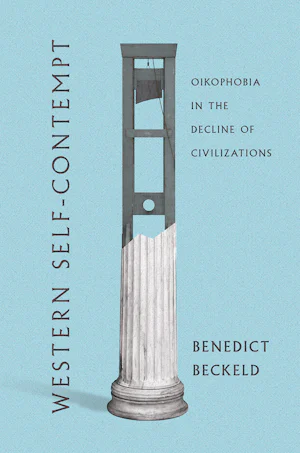
Benedict Beckeld explores oikophobia, described by its coiner Sir Roger Scruton as "the felt need to denigrate the customs, culture and institutions that are identifiably 'ours,'" in its political and philosophical applications.
Beckeld analyzes the theories behind oikophobia along with their historical sources, revealing why oikophobia is best described as a cultural malaise that befalls civilizations during their declining days.
Beckeld gives a framework for why today's society is so fragmented and self-critical. He demonstrates that oikophobia is the antithesis of xenophobia.
By this definition, the riots and civil unrest in the summer of 2020 were an expression of oikophobia. Excessive political correctness that attacks tradition and history is an expression of oikophobia.
Beckeld argues that if we are to understand these behaviors and attitudes, we must understand oikophobia as a sociohistorical phenomenon.
Western Self-Contempt is a systematic analysis of oikophobia, combining political philosophy and history to examine how Western civilizations and cultures evolve from naïve and self-promoting beginnings to states of self-loathing and decline.
Concluding with a philosophical portrait of an increasingly interconnected Western civilization, Beckeld reveals how past events and ideologies, both in the US and in Europe, have led to a modern culture of self-questioning and self-rejection.
Western Self-Contempt travels through civilizations since antiquity, examining major political events and the literature of ancient Greece, Rome, France, Britain, and the United States, to study evidence of cultural self-hatred and its cyclical recurrence.
Benedict Beckeld explores oikophobia, described by its coiner Sir Roger Scruton as "the felt need to denigrate the customs, culture and institutions that are identifiably 'ours,'" in its political and philosophical applications.
Beckeld analyzes the theories behind oikophobia along with their historical sources, revealing why oikophobia is best described as a cultural malaise that befalls civilizations during their declining days.
Beckeld gives a framework for why today's society is so fragmented and self-critical.
He demonstrates that oikophobia is the antithesis of xenophobia.
By this definition, the riots and civil unrest in the summer of 2020 were an expression of oikophobia.
Excessive political correctness that attacks tradition and history is an expression of oikophobia.
Beckeld argues that if we are to understand these behaviors and attitudes, we must understand oikophobia as a sociohistorical phenomenon.
Western Self-Contempt is a systematic analysis of oikophobia, combining political philosophy and history to examine how Western civilizations and cultures evolve from naïve and self-promoting beginnings to states of self-loathing and decline.
Concluding with a philosophical portrait of an increasingly interconnected Western civilization, Beckeld reveals how past events and ideologies, both in the US and in Europe, have led to a modern culture of self-questioning and self-rejection.
 cornellpress.cornell.edu
Benedict Beckeld explores oikophobia, described by its coiner Sir Roger Scruton as "the felt need to denigrate the customs, culture and institutions that are identifiably 'ours,'" in its political and philosophical applications.
Beckeld analyzes the theories behind oikophobia along with their historical sources, revealing why oikophobia is best described as a cultural malaise that befalls civilizations during their declining days.
Beckeld gives a framework for why today's society is so fragmented and self-critical.
He demonstrates that oikophobia is the antithesis of xenophobia.
By this definition, the riots and civil unrest in the summer of 2020 were an expression of oikophobia.
Excessive political correctness that attacks tradition and history is an expression of oikophobia.
Beckeld argues that if we are to understand these behaviors and attitudes, we must understand oikophobia as a sociohistorical phenomenon.
Western Self-Contempt is a systematic analysis of oikophobia, combining political philosophy and history to examine how Western civilizations and cultures evolve from naïve and self-promoting beginnings to states of self-loathing and decline.
Concluding with a philosophical portrait of an increasingly interconnected Western civilization, Beckeld reveals how past events and ideologies, both in the US and in Europe, have led to a modern culture of self-questioning and self-rejection.
Western Self-Contempt by Benedict Beckeld | Hardcover | Cornell University Press
Western Self-Contempt travels through civilizations since antiquity, examining major political events and the literature of ancient Greece, Rome, France, Britain, and the United States, to study evidence...
cornellpress.cornell.edu