blackascoal
The Force is With Me
The U.S. Open tennis champion’s biracial identity is inconvenient in a racist narrative that turns Serena Williams into a stereotype.

They don’t know what to do with Naomi Osaka.
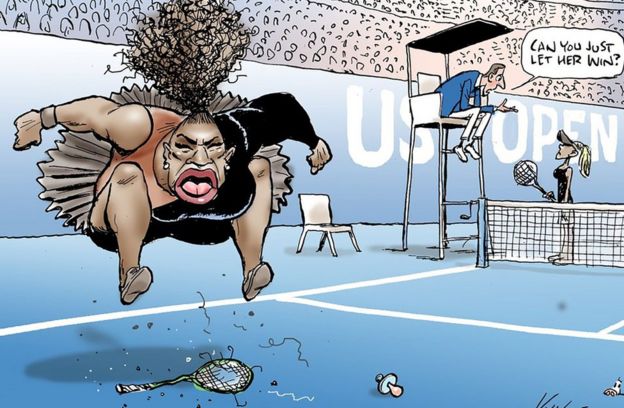
In a cartoon he drew for Australia’s Herald Sun on Sept. 10, illustrator Mark Knight depicts Serena Williams during the finals match at the U.S. Open Tennis Championships. It’s a classic racist caricature: Williams appears as a hulk-like figure with unkempt hair and large lips reminiscent of the minstrel or the mammy.
Behind Williams is her competitor, Naomi Osaka. Her appearance has been distilled down to its lowest-common-denominator characteristics: light skin, slim frame, blonde hair. She might as well be Maria Sharapova.
Caricatures, by their nature, are meant to distort and exaggerate. But they’re also meant to be symbolic, representative; short-hand for a concept or idea.
Here, the narrative is clear: Williams has been cast as the big, ugly, angry black woman. Osaka, by contrast, has been cast as the innocent white girl, even though she’s not even white.
Knight’s cartoon is what happens when we flatten whole human beings into types, when the story and its narratives become far more important than the nuance. In the process, racist and sexist assumptions are perpetuated and we strip people of their right to be weak and strong, of the totality of their humanity.
Here is the bottom line: On Saturday, two talented tennis players ― one black, one Japanese and black ― played a deeply emotional game, and those emotions came brimming to the surface for a whole host of reasons.
But it wasn’t a matter of villain and victim, good and bad, black and white. Williams is an icon, a legend. And she’s a fallible and whole human being. Just as Osaka is more than just Japanese, more than tearful and endearingly apologetic. She’s a fierce competitor with a distinct personal history, not a symbol of acceptable blackness to weaponize against Williams.
Indeed, she is many things, but what perhaps matters most is who she sees herself as, especially on the court:
“I’m just a tennis player playing another tennis player,” Osaka explained after she accepted her trophy.
https://www.huffingtonpost.com/entry/the-whitewashing-of-naomi-osaka_us_5b967eb3e4b0cf7b004209b5
They don’t know what to do with Naomi Osaka.
In a cartoon he drew for Australia’s Herald Sun on Sept. 10, illustrator Mark Knight depicts Serena Williams during the finals match at the U.S. Open Tennis Championships. It’s a classic racist caricature: Williams appears as a hulk-like figure with unkempt hair and large lips reminiscent of the minstrel or the mammy.
Behind Williams is her competitor, Naomi Osaka. Her appearance has been distilled down to its lowest-common-denominator characteristics: light skin, slim frame, blonde hair. She might as well be Maria Sharapova.
Caricatures, by their nature, are meant to distort and exaggerate. But they’re also meant to be symbolic, representative; short-hand for a concept or idea.
Here, the narrative is clear: Williams has been cast as the big, ugly, angry black woman. Osaka, by contrast, has been cast as the innocent white girl, even though she’s not even white.
Knight’s cartoon is what happens when we flatten whole human beings into types, when the story and its narratives become far more important than the nuance. In the process, racist and sexist assumptions are perpetuated and we strip people of their right to be weak and strong, of the totality of their humanity.
Here is the bottom line: On Saturday, two talented tennis players ― one black, one Japanese and black ― played a deeply emotional game, and those emotions came brimming to the surface for a whole host of reasons.
But it wasn’t a matter of villain and victim, good and bad, black and white. Williams is an icon, a legend. And she’s a fallible and whole human being. Just as Osaka is more than just Japanese, more than tearful and endearingly apologetic. She’s a fierce competitor with a distinct personal history, not a symbol of acceptable blackness to weaponize against Williams.
Indeed, she is many things, but what perhaps matters most is who she sees herself as, especially on the court:
“I’m just a tennis player playing another tennis player,” Osaka explained after she accepted her trophy.
https://www.huffingtonpost.com/entry/the-whitewashing-of-naomi-osaka_us_5b967eb3e4b0cf7b004209b5