Strait of Hormuz shipping traffic is effectively at a standstill despite ceasefire- Iran says ships wanting to transit need Iranian permission

Iran (via the IRGC Navy) enforces control through a mix of asymmetric and standoff weapons that lightly armed merchant ships cannot defeat:
  • Shore- and sea-based missiles, drones, and USVs: Anti-ship cruise/ballistic missiles, armed UAVs, and unmanned surface vessels have already struck or threatened 20+ commercial ships since February 2026.

Low tech systems like Iran deploys are easily counted by current technology. The only time these have worked against ships is when those ships are completely unarmed. That's hardly a threat if the shipping companies started carrying defense systems.
  • Mines and fast-attack craft: Persistent mine risks and small-boat swarms remain active threats.

Yea, sure. Maybe you can raise a few off the bottom of the ocean. Puny motorboats with some AK armed rabble aboard would be no threat if a merchant ship had a couple of .50 machineguns or 20mm cannon mounted. What you're calling a threat is really just an amateurish joke because Iran doesn't have the means to produce an actual navy.
  • Selective “toll booth” regime: Ships must coordinate via VHF, provide crew/ownership details, pay fees (up to $2 million in some cases), and follow IRGC-mandated routes in Iranian territorial waters. Unauthorized attempts trigger warnings of destruction.

That can easily be ignored. I'm surprised more merchants aren't simply turning off their maritime trackers and moving hugging the coast of the UAE through the straight. Iran has no way to stop that.
Private maritime security companies (PMSCs) offer no defense against these. Merchants lack military-grade sensors, damage control, or firepower. Even WWII-style “armed merchantmen” (with deck guns) were vulnerable to state navies and are irrelevant here.

So does Iran.
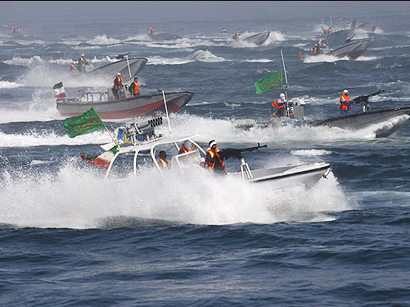
irgc_speed_boats_070414.jpg


That's a joke, not a navy.
 
Low tech systems like Iran deploys are easily counted by current technology. The only time these have worked against ships is when those ships are completely unarmed. That's hardly a threat if the shipping companies started carrying defense systems.


Yea, sure. Maybe you can raise a few off the bottom of the ocean. Puny motorboats with some AK armed rabble aboard would be no threat if a merchant ship had a couple of .50 machineguns or 20mm cannon mounted. What you're calling a threat is really just an amateurish joke because Iran doesn't have the means to produce an actual navy.


That can easily be ignored. I'm surprised more merchants aren't simply turning off their maritime trackers and moving hugging the coast of the UAE through the straight. Iran has no way to stop that.


So does Iran.

irgc_speed_boats_070414.jpg


That's a joke, not a navy.


Please let me know if any ship owners take your suggestions seriously.
 
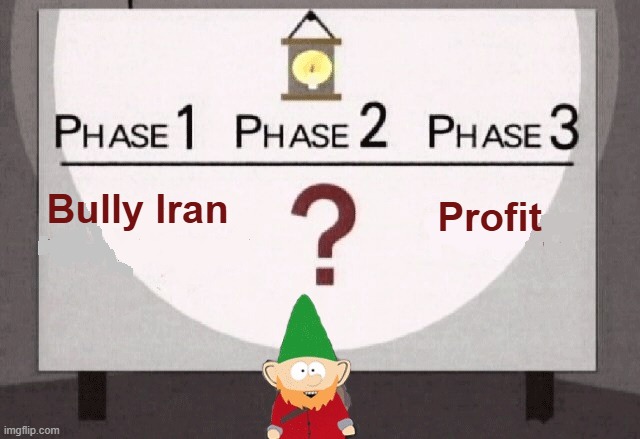
MAGAt plan to open the Strait of Hormuz using the same strategy as the Underpants Gnomes:

ap028b.jpg
 
Lets Make Iran great and rich again and ignore the same regime is in place with even more hardline leadership.

#MAGA
#NoMoreForeignWars
#AmericaFirst
#MakeAlliesPayUpWhilePartneringWithIranToMakeBank

ap09k4.jpg
 
Lets Make Iran great and rich again and ignore the same regime is in place with even more hardline leadership.

#MAGA
#NoMoreForeignWars
#AmericaFirst
#MakeAlliesPayUpWhilePartneringWithIranToMakeBank

ap09k4.jpg
ap02p3.jpg
 
  • Like
Reactions: QP!
Masses of cheap drones have been tried since WW 2 (the V-1 was the first drone used in mass) and have failed every time. Cheap drones will only make cheap countermeasures a reality.

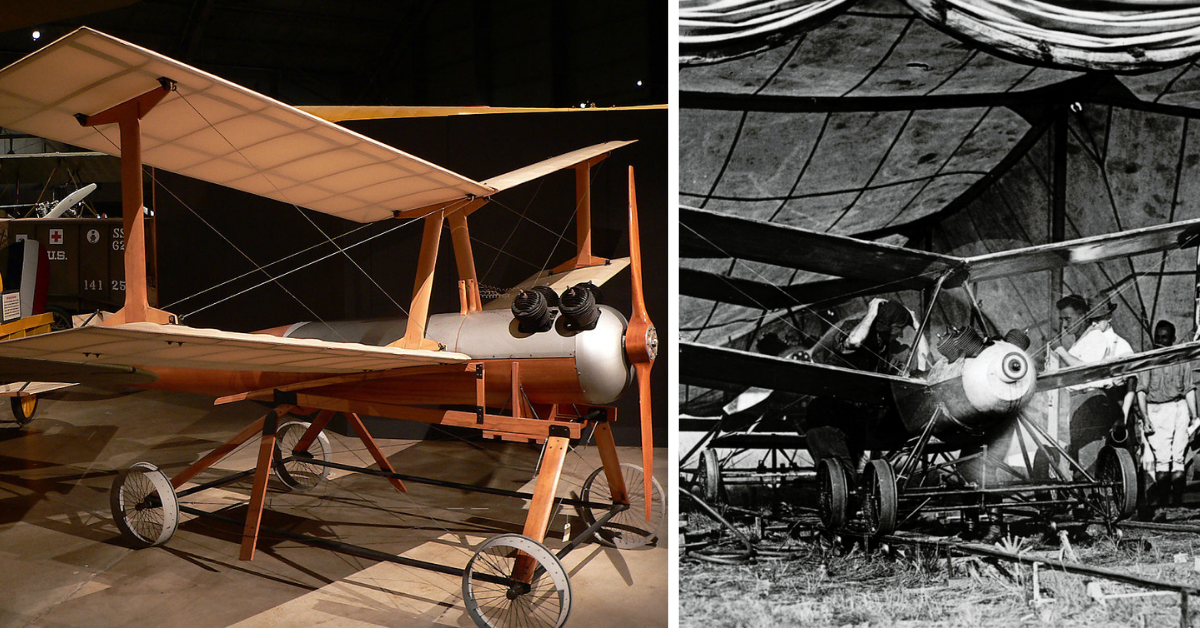
Hell, we could go back to WW 1 and the Kettering Bug as a "cheap drone."

the-kettering-bug.png


A one-dimensional approach to attacking an enemy with options means your attacks quickly become ineffective.
As cheap drones continue to change the face and focus of the battlefield (see short video below), Terry continues to cite WW1 'drones' to make the case that drone technology has not really changed and is not changing in its useful today as opposed to over 100 years ago.


it s a version of the same failed argument he makes against almost any technology advancement as he also argues EV's are no more useful or advanced now for average users than when the earlist EV's emerged in the early 1900's. He argues nothing has really changed to make them more of a practical choice.

Yes he is that stupid :rofl2: :rofl2:
 
As cheap drones continue to change the face and focus of the battlefield (see short video below), Terry continues to cite WW1 'drones' to make the case that drone technology has not really changed and is not changing in its useful today as opposed to over 100 years ago.


it s a version of the same failed argument he makes against almost any technology advancement as he also argues EV's are no more useful or advanced now for average users than when the earlist EV's emerged in the early 1900's. He argues nothing has really changed to make them more of a practical choice.

Yes he is that stupid :rofl2: :rofl2:
The drones haven't changed that much since WW 2. What has changed is the electronics have gotten better. But that is a temporary advantage at best, like all military technology is.

Same thing with EV's, which by the way are doing poorly on sales in anything other than a government forced market.

Yes, you are that stupid.
 
The drones haven't changed that much since WW 2.
Yes they have. What you are saying is stupid.

What has changed is the electronics have gotten better.
Yes which is why what you are saying is stupid. The electronics and AI are part of the drones and yet you seem to be treating as seperate.

It would be like saying the airplanes have not really changed much since WW2 or even WW1 if you remove the 'Electronics (computer)' they end up being quite similar.


But that is a temporary advantage at best, like all military technology is.
Sure there will be catch up and i said that.

Does NOT change that they are changing the face of the battle field in the way early tanks did and other innovations. That 'catch up' happens does not negate that.

Same thing with EV's, which by the way are doing poorly on sales in anything other than a government forced market.

Yes, you are that stupid.
Ha says the guy who enter premise of 'drones have not changed much if you ignore the electronics and AI. One of the most stupid ways to assess drones.
 
As cheap drones continue to change the face and focus of the battlefield (see short video below), Terry continues to cite WW1 'drones' to make the case that drone technology has not really changed and is not changing in its useful today as opposed to over 100 years ago.


it s a version of the same failed argument he makes against almost any technology advancement as he also argues EV's are no more useful or advanced now for average users than when the earlist EV's emerged in the early 1900's. He argues nothing has really changed to make them more of a practical choice.

Yes he is that stupid :rofl2: :rofl2:
It's best, IMHO, to ignore demented dumbasses. They are stuck in the past. It's not really their fault that they can't help themselves. It's one reason so many regress to childhood where they are children who need a Daddy.

As for drones, the Iranians mined the Persian Gulf and the Strait in the late 80s. Helicopters with crews wearing NVGs proved it was the Iranians. They were loading transports with mines out to their oil rigs in the Gulf and then using motor whaleboats to carry them across at night to be deployed in the shipping lanes. Besides hitting tankers, they also hit one of our frigates, the USS Samuel B. Roberts, and almost sank it. In retaliation, the US launched Operation Praying Mantis and blew the shit out of Iranian ships and oil platforms. That quieted them down until Trump started Operation Epstein Distraction over 3 decades later.

Now, with the advent of drones, the Iranians are able to do something they couldn't do in 1988; close the Strait of Hormuz for months on end and are in the process of doing the same for the Red Sea/Suez Canal. Anyone who doesn't understand how drones have changed the face of war is a fucking moron and should be ignored as a demented idiot.


View: https://x.com/NavalInstitute/status/1781001932653408645


Commissioned in 1986, the ship was severely damaged by an Iranian mine in 1988, leading U.S. forces to respond with Operation Praying Mantis. Repaired and returned to duty, the ship served until decommissioned in 2015....

.... Samuel B. Roberts had arrived in the Persian Gulf and was heading for a refueling rendezvous with USS San Jose on 14 April when the ship struck an Iranian mine in the central Persian Gulf, an area she had safely transited a few days earlier. The mine blew a 15-foot (4.6
m) hole in the hull, flooded the engine room,[1] and knocked the two gas turbines from their mounts. The blast also broke the keel of the ship; such structural damage is almost always fatal to a vessel. The crew fought fire and flooding for five hours and saved the ship.


On 18 April, the U.S. Navy attacked with several groups of surface warships, plus aircraft from the aircraft carrier USS Enterprise, and her cruiser escort, USS Truxtun. The action began with coordinated strikes by two surface groups.

One surface action group, or SAG, consisting of the destroyers USS Merrill (including embarked LAMPS Mk I helicopter detachment HSL-35 Det 1 Helicopter Anti-Submarine Squadron Light 35) and USS Lynde McCormick, plus the amphibious transport dock USS Trenton and its embarked Marine air-ground task force (Contingency MAGTF 2-88 from Camp LeJeune, North Carolina)[8] and the LAMPS helicopter detachment (HSL-44 Det 5) from USS Samuel B. Roberts, was ordered to destroy the guns and other military facilities on the Sassan oil platform.

In 1986, the Navy named a third Samuel B. Roberts, one of the final Perry-class frigates. Sent to escort tanker ships through the hellish seas of the Iran-Iraq War, FFG 58 performed brilliantly in dangerous and tight waters. Then an Iranian mine blew a truck-size hole in the ship's engineroom, leaving it dead in the water off a hostile coast. Well-trained and well-led, the crew fought fire and flood into the night, and saved their ship to fight another day. Like its predecessors, the third Roberts leaves behind a legacy befitting the highest traditions of the naval service — and in particular its unofficial motto, "Don't give up the ship."
1785619182908.png
 
Yes they have. What you are saying is stupid.

Let's see: They are wheeled or tracked on land for the most part. Walkers are experimental still. On sea they are fast small boats. In the air they are conventional aircraft using either a prop / piston or jet engine for propulsion. They are in conventional and less conventional aerodynamic shapes, but nothing really new or that hasn't been tried before.

jb-1_jet.jpg


49598fbcc3a97050e7314e2d3d4ec697


Old, meet new. SSDD.
Yes which is why what you are saying is stupid. The electronics and AI are part of the drones and yet you seem to be treating as seperate.

Any drone body could be fitted with some set of electronics. All you need is the internal volume. Many drones get electronics swapped out depending on the mission they are serving. The electronics ARE separate from the drone.
It would be like saying the airplanes have not really changed much since WW2 or even WW1 if you remove the 'Electronics (computer)' they end up being quite similar.

A Boeing 737 built in 1966 is not very different from one built in 2026, 60 years later in terms of the airframe. Sure, there are incremental improvements, different engines, and very much updated electronics, but either is still the same basic airframe. You could take a 737-100 and update it to a near equivalent of a 737 MAX 7 with little more than an engine swap and new electronics and avionics.
Sure there will be catch up and i said that.

But you clearly don't get it. Iran is already finding their drones and ballistic missiles rarely getting through defense systems across the Middle East. Sure, a few leak through, but it's a tiny fraction of the whole.
Does NOT change that they are changing the face of the battle field in the way early tanks did and other innovations. That 'catch up' happens does not negate that.

Early tanks didn't have grand impact. In WW 1 they were quickly countered with both existing weapons and new specific antitank ones. The French and British didn't change their tactics. The Germans changed their tactics with the use of stroßtruppen tactics and nearly won that war during the 1918 Kaiser's offensives.

Maybe you should actually study WW 1 tank actions. I recommend The Fighting Tanks 1916-1933 by Jones, Rarey, and Icks. Tanks never scored the major breakthrough of enemy lines predicted.
Ha says the guy who enter premise of 'drones have not changed much if you ignore the electronics and AI. One of the most stupid ways to assess drones.
And I'm 100% correct. It is you're myopic, amateurish view gotten from watching too much BS-NOW and CNN.
 
It's best, IMHO, to ignore demented dumbasses. They are stuck in the past. It's not really their fault that they can't help themselves. It's one reason so many regress to childhood where they are children who need a Daddy.
That's why I rarely respond to your posts anymore.
 
Let's see: They are wheeled or tracked on land for the most part. Walkers are experimental still. On sea they are fast small boats. In the air they are conventional aircraft using either a prop / piston or jet engine for propulsion. They are in conventional and less conventional aerodynamic shapes, but nothing really new or that hasn't been tried before.

jb-1_jet.jpg


49598fbcc3a97050e7314e2d3d4ec697


Old, meet new. SSDD.


Any drone body could be fitted with some set of electronics. All you need is the internal volume. Many drones get electronics swapped out depending on the mission they are serving. The electronics ARE separate from the drone.


A Boeing 737 built in 1966 is not very different from one built in 2026, 60 years later in terms of the airframe. Sure, there are incremental improvements, different engines, and very much updated electronics, but either is still the same basic airframe. You could take a 737-100 and update it to a near equivalent of a 737 MAX 7 with little more than an engine swap and new electronics and avionics.


But you clearly don't get it. Iran is already finding their drones and ballistic missiles rarely getting through defense systems across the Middle East. Sure, a few leak through, but it's a tiny fraction of the whole.


Early tanks didn't have grand impact. In WW 1 they were quickly countered with both existing weapons and new specific antitank ones. The French and British didn't change their tactics. The Germans changed their tactics with the use of stroßtruppen tactics and nearly won that war during the 1918 Kaiser's offensives.

Maybe you should actually study WW 1 tank actions. I recommend The Fighting Tanks 1916-1933 by Jones, Rarey, and Icks. Tanks never scored the major breakthrough of enemy lines predicted.

And I'm 100% correct. It is you're myopic, amateurish view gotten from watching too much BS-NOW and CNN.
No Terry.

When we speak of drone functionality and if they are changing the battle field you CANNOT seperate the drone body from the electronics and AI and say nothing is changed under a premise of saying you could put that Electronics and AI in the older bodies and get similar functionality.

You act as if drone warfare is a fucntion of the body structure only when the immense change IS THE ELECTRONICS AND AI.

So your error ans stupidity is to continue to say 'drones today are the same as those from WW2 if we ignore the AI and electronics'.

You are stupid beyond comprehension when it comes to technology.
 
It's best, IMHO, to ignore demented dumbasses. They are stuck in the past. It's not really their fault that they can't help themselves. It's one reason so many regress to childhood where they are children who need a Daddy.

As for drones, the Iranians mined the Persian Gulf and the Strait in the late 80s. Helicopters with crews wearing NVGs proved it was the Iranians. They were loading transports with mines out to their oil rigs in the Gulf and then using motor whaleboats to carry them across at night to be deployed in the shipping lanes. Besides hitting tankers, they also hit one of our frigates, the USS Samuel B. Roberts, and almost sank it. In retaliation, the US launched Operation Praying Mantis and blew the shit out of Iranian ships and oil platforms. That quieted them down until Trump started Operation Epstein Distraction over 3 decades later.

Now, with the advent of drones, the Iranians are able to do something they couldn't do in 1988; close the Strait of Hormuz for months on end and are in the process of doing the same for the Red Sea/Suez Canal. Anyone who doesn't understand how drones have changed the face of war is a fucking moron and should be ignored as a demented idiot.


View: https://x.com/NavalInstitute/status/1781001932653408645


Commissioned in 1986, the ship was severely damaged by an Iranian mine in 1988, leading U.S. forces to respond with Operation Praying Mantis. Repaired and returned to duty, the ship served until decommissioned in 2015....

.... Samuel B. Roberts had arrived in the Persian Gulf and was heading for a refueling rendezvous with USS San Jose on 14 April when the ship struck an Iranian mine in the central Persian Gulf, an area she had safely transited a few days earlier. The mine blew a 15-foot (4.6 m) hole in the hull, flooded the engine room,[1] and knocked the two gas turbines from their mounts. The blast also broke the keel of the ship; such structural damage is almost always fatal to a vessel. The crew fought fire and flooding for five hours and saved the ship.


On 18 April, the U.S. Navy attacked with several groups of surface warships, plus aircraft from the aircraft carrier USS Enterprise, and her cruiser escort, USS Truxtun. The action began with coordinated strikes by two surface groups.

One surface action group, or SAG, consisting of the destroyers USS Merrill (including embarked LAMPS Mk I helicopter detachment HSL-35 Det 1 Helicopter Anti-Submarine Squadron Light 35) and USS Lynde McCormick, plus the amphibious transport dock USS Trenton and its embarked Marine air-ground task force (Contingency MAGTF 2-88 from Camp LeJeune, North Carolina)[8] and the LAMPS helicopter detachment (HSL-44 Det 5) from USS Samuel B. Roberts, was ordered to destroy the guns and other military facilities on the Sassan oil platform.


In 1986, the Navy named a third Samuel B. Roberts, one of the final Perry-class frigates. Sent to escort tanker ships through the hellish seas of the Iran-Iraq War, FFG 58 performed brilliantly in dangerous and tight waters. Then an Iranian mine blew a truck-size hole in the ship's engineroom, leaving it dead in the water off a hostile coast. Well-trained and well-led, the crew fought fire and flood into the night, and saved their ship to fight another day. Like its predecessors, the third Roberts leaves behind a legacy befitting the highest traditions of the naval service — and in particular its unofficial motto, "Don't give up the ship."
View attachment 90921
it is a psychosis with Terry.

He is in denial about any all technology improvements since the 1900's.

There are countless scholary articles from countless think tanks and military experts speaking to how drones are changing the battlefield and a new drones arm race has begun.

Terry replies to that with 'nuh uh' and hand waves it away, like an idiot, telling the experts all drones still operate at WW2 levels.

He is stupid beyond reach.


Scholarly literature shows that low-cost drones have fundamentally transformed modern warfare by creating mass saturation effects, increasing battlefield transparency, and upending traditional cost-asymmetry models. Key themes from security studies and military analysis focus on the shift from high-end platforms to commercial dual-use tech, the tactical realities in Ukraine, and the challenges of force protection. [1, 2, 3, 4, 5]
 
But Terry says 'nuh uh... everything below is the same since WW2'.

Key Scholarly and Strategic Insights
    • The "Mass Effect" of Low-Cost Tech: Research published by the USAWC Press notes that inexpensive, commercially available drones create a mass effect that challenges traditional force planning. [1]
    • Asymmetric Cost Dilemmas: Studies emphasize how a few-hundred-dollar first-person view (FPV) drone can destroy multi-million-dollar armored vehicles, forcing militaries into a severe financial deficit when intercepting them with high-end missiles. [1, 2]
    • Battlefield Transparency: Constant aerial surveillance thins out concentrated ground troops and restricts large-scale tactical maneuvers, turning lower airspace into an active kill zone. [1, 2]
 
As cheap drones continue to change the face and focus of the battlefield (see short video below), Terry continues to cite WW1 'drones' to make the case that drone technology has not really changed and is not changing in its useful today as opposed to over 100 years ago.
Drones won't win a battle, Kewpie. They have very little range, and even less firepower.

it s a version of the same failed argument he makes against almost any technology advancement as he also argues EV's are no more useful or advanced now for average users than when the earlist EV's emerged in the early 1900's. He argues nothing has really changed to make them more of a practical choice.

Yes he is that stupid :rofl2: :rofl2:
EVs are not a technology advancement, Kewpie. They are older than gasoline cars.
He is correct. Nothing has really changed to make them a practical choice. They have limited range, take too long to 'refuel', they are expensive, and they are very heavy.

Gasoline cars succeed because they effectively have infinite range, can be refueled in a few minutes, they work more reliability in inclement weather, they are cheap and poweful, and they are far more efficient than EVs.
 
Yes they have. What you are saying is stupid.
Nope. Drones are still pretty much the same.
Yes which is why what you are saying is stupid. The electronics and AI are part of the drones and yet you seem to be treating as seperate.
Electronics won't save a drone.
AI won't save a drone. Indeed, it makes it easier to destroy it.
It would be like saying the airplanes have not really changed much since WW2 or even WW1 if you remove the 'Electronics (computer)' they end up being quite similar.
They really haven't. Airplanes still use two wings, a stabilizer surface (front or rear), have an engine, and still require fuel to fly. Navigation methods have changed somewhat, but you still take off the same way, you still land them the same way, you still talk to ATC the same way (if you talk to them at all!), the instrumentation still reports the same things, and they all still need the same kind of maintenance.
Sure there will be catch up and i said that.

Does NOT change that they are changing the face of the battle field in the way early tanks did and other innovations.
A drone is not a tank, Kewpie.
That 'catch up' happens does not negate that.


Ha says the guy who enter premise of 'drones have not changed much if you ignore the electronics and AI. One of the most stupid ways to assess drones.
T.A. Gardner happens to be correct. Drones have not significantly changed. They are still the same automated or semi-automated aircraft.
They have short range, and even less firepower.
 
But Terry says 'nuh uh... everything below is the same since WW2'.

Key Scholarly and Strategic Insights
    • The "Mass Effect" of Low-Cost Tech: Research published by the USAWC Press notes that inexpensive, commercially available drones create a mass effect that challenges traditional force planning. [1]
No significant change. Drones have short range, very little firepower, and are easily shot down.
They are pretty useless, Kewpie.
    • Asymmetric Cost Dilemmas: Studies emphasize how a few-hundred-dollar first-person view (FPV) drone can destroy multi-million-dollar armored vehicles, forcing militaries into a severe financial deficit when intercepting them with high-end missiles. [1, 2]
No such study. Stop making shit up.
    • Battlefield Transparency: Constant aerial surveillance thins out concentrated ground troops and restricts large-scale tactical maneuvers, turning lower airspace into an active kill zone. [1, 2]
Drones don't kill much, and they are easily shot down.
 
Let's see: They are wheeled or tracked on land for the most part. Walkers are experimental still. On sea they are fast small boats. In the air they are conventional aircraft using either a prop / piston or jet engine for propulsion. They are in conventional and less conventional aerodynamic shapes, but nothing really new or that hasn't been tried before.

jb-1_jet.jpg


49598fbcc3a97050e7314e2d3d4ec697


Old, meet new. SSDD.


Any drone body could be fitted with some set of electronics. All you need is the internal volume. Many drones get electronics swapped out depending on the mission they are serving. The electronics ARE separate from the drone.


A Boeing 737 built in 1966 is not very different from one built in 2026, 60 years later in terms of the airframe.
Quite right. There is a doubler above the passenger doorways, and the navigation systems are using electronic displays as well as the 'steam gauge' type instruments (which are still there!). Indeed, the 737 itself is a slight modification of the 707 airframe.

Sure, there are incremental improvements, different engines, and very much updated electronics, but either is still the same basic airframe. You could take a 737-100 and update it to a near equivalent of a 737 MAX 7 with little more than an engine swap and new electronics and avionics.
Exactly. The biggest reason for the electronics change is that aircraft are using GPS more to navigate, ILS is more common, and the DF and RS navigation stations are no longer in service. You don't even need DME much anymore. VORTAC is still there as it was in the 60's, and is still used in exactly the same way.
But you clearly don't get it. Iran is already finding their drones and ballistic missiles rarely getting through defense systems across the Middle East. Sure, a few leak through, but it's a tiny fraction of the whole.
Exactly. Iran will be reduced to throwing rocks if they continue to attack shipping and its neighbors.
Early tanks didn't have grand impact. In WW 1 they were quickly countered with both existing weapons and new specific antitank ones. The French and British didn't change their tactics. The Germans changed their tactics with the use of stroßtruppen tactics and nearly won that war during the 1918 Kaiser's offensives.
The earliest tank was a washtub a Frenchman through over himself to get across the battlefield. It didn't work very well.

WW1 had no winners or losers. It ended in armistice. They simply gave up and went home. No significant change in any boundary occurred.

A drone, of course, is no tank.
Maybe you should actually study WW 1 tank actions. I recommend The Fighting Tanks 1916-1933 by Jones, Rarey, and Icks. Tanks never scored the major breakthrough of enemy lines predicted.

And I'm 100% correct. It is you're myopic, amateurish view gotten from watching too much BS-NOW and CNN.
 
Back
Top