
Jake Starkey
Verified User
It would be a thing.


the golden rule is the only rational take-away from christianity and Judaism.Defending speculation life isn't self evident when protected by rule of law suggesting relative time logistics are the only facts allowed in a court of law in every society humanity defends daily isn't accomplished by social consensus established throughout history of genetics leaving every reproduction physiclaly limited to adapting in palin sight located in their relative time dispalcement as part of a specific ancestral lineage and generation gap currently located by longitude and latitude inhabing space now.
Pick a side debating how tomorrow arrives or else. No pressure to sacrifice my biological time for relative time theatrics daily here. go pound salt out of sea water.
the protocols to serve humanity is everyone ancestrally here has to pick an ideology to die for cradle to grave or be shunned by your own ancestry, exiled by your own ideology, executed for treason agains state of minds and blasphemy for not believing now isn't eternity.
want to discuss the theology around Jesus and why he got nailed to a cross by the same empire that built Christianity around the guy 4 centuries after his death?


Correct answer!Maybe.

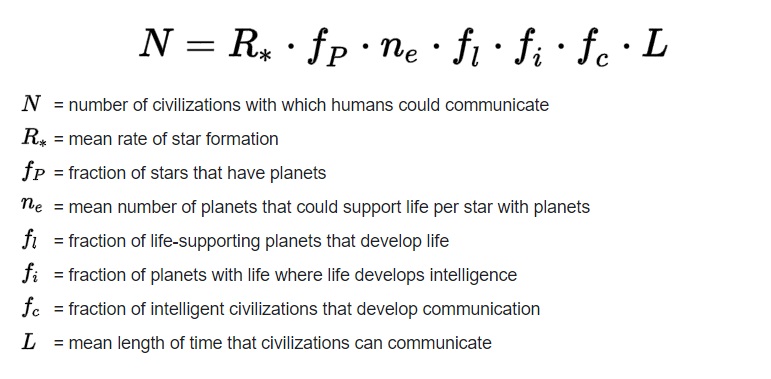

 www.omnicalculator.com
On the other hand, we may well evolve the intelligence that replaces us in the form of machines and electronics... We make great pets. Maybe that's a natural part of evolution for a species that develops tools and technology. Who knows? Maybe such a civilization, tens to say, a million years ahead of us in technological evolution already has and is watching us like some nature experiment. We really don't know what comes next.The question of whether there is significantly more intelligent life out there is probably more important...and, for me, more interesting.
I kinda hope so, because I think we humans are not especially intelligent.
BUT...if all life evolves more or less the way it appears to have evolved on Earth...WE may be about as evolved in intelligence as it is possible to get. We look like we are about to destroy ourselves (and everything else living on the planet)...and maybe that is the way things go everywhere. An evolving entity gets about as far along as we are...to a point where it is capable of destroying everything...and..poof.
Ya know...why not?

 www.ranker.com
Yup. That is why I think some form of, "Beats the shit out of me" is the answer to this question that suits me best.On the other hand, we may well evolve the intelligence that replaces us in the form of machines and electronics... We make great pets. Maybe that's a natural part of evolution for a species that develops tools and technology. Who knows? Maybe such a civilization, tens to say, a million years ahead of us in technological evolution already has and is watching us like some nature experiment. We really don't know what comes next.
As far as destruction goes, if tomorrow Yellowstone erupted and massively did so, it would cause more destruction to the US than a nuclear war.
Any one of these would do the same to some part of the planet.
The World's 6 Major Supervolcanoes
Explore Earth's most powerful geological forces: supervolcanoes. From Yellowstone to Lake Toba, discover the world's six sleeping giants capable of global ...
that's not intelligence.On the other hand, we may well evolve the intelligence that replaces us in the form of machines and electronics... We make great pets. Maybe that's a natural part of evolution for a species that develops tools and technology. Who knows? Maybe such a civilization, tens to say, a million years ahead of us in technological evolution already has and is watching us like some nature experiment. We really don't know what comes next.
As far as destruction goes, if tomorrow Yellowstone erupted and massively did so, it would cause more destruction to the US than a nuclear war.
Any one of these would do the same to some part of the planet.
The World's 6 Major Supervolcanoes
Explore Earth's most powerful geological forces: supervolcanoes. From Yellowstone to Lake Toba, discover the world's six sleeping giants capable of global ...
ok, Eeyore.We have learned a lot more about the universe since the days when many people assumed life would be common and widespread in the universe.
First, even though we've been studying it for at least 70 years we have really do not know how coded information-bearing molecules like DNA and complex cellular biology emerge and get organized from inert non-biological chemicals.
We can probably immediately write off 90 percent of stars as candidates for life. The vast majority of stars in the universe are red dwarfs don't put out enough solar radiation for anything like photosynthesis, and red dwarves are infamous for violent gamma ray bursts which likely cook any life in the vicinity.
You can probably write off all the old galaxies and dwarf galaxies which are too poor in metals to support life.
You can write off all the O and B class giant stars, which don't exist long enough for biological evolution to kick into gear.
You can probably write off all rocky planets which don't have a magenetic field.
You can write off all rocky planets that don't have a narrow temperature range conducive to liquid water.
You can probably write off all planets that don't have plate tectonics to recycle nutrients and concentrate mineral ores which would be needed for metallurgy.
You can write off all rocky planets that don't have stable atmospheres with at least around 20 percent free oxygen, because then you can't have self sustaining fire and metallurgy, which would be necessary for a technological civilization.

thanks for the middling intellect puke session, fellow retards.Thanks, Ross, Cypress, and T. A. for the above.
I don't know the answer, and I don't think about it all unless asked, and I don't get asked all that much.
Stop thinking that Hollyweird movies are real.that's not intelligence.
that's an extinction level event and totally stupid.
its not evolution. its attempted mass murder, you fool.
evolution is not building a bunch of machines to replace everyone.Stop thinking that Hollyweird movies are real.
AI and intelligent machines won't replace us, they'll simply succeed us. That's why I said, "We'll make great pets."evolution is not building a bunch of machines to replace everyone.
that's genocide, you sick freak.
sell your evil somewhere else.
that's stupid.AI and intelligent machines won't replace us, they'll simply succeed us. That's why I said, "We'll make great pets."
You have the Hollywood mindset on this.
why would a machine want a pet?AI and intelligent machines won't replace us, they'll simply succeed us. That's why I said, "We'll make great pets."
You have the Hollywood mindset on this.
Why not?why would a machine want a pet?