Like a Klingon prison’: inside Barack Obama’s audacious, near-windowless, $850m presidential library
Towering over a low-income area of Chicago, and wrapped in a speech that’s hard to decipher, this controversial monolith feels like a menacing sci-fi HQ. Is it a monument – or a mausoleum?
The Egyptians had their pyramids. The Anglo-Saxons had their barrows. And the Americans have their presidential libraries – the chief difference being that the leaders the US venerates are usually still alive at the opening.
Lacking a royal family or a state religion, the US presidency has swelled to fill the void, transforming over the decades into a national personality cult, complete with its own secular temples to these powerful men. The latest pharaonic edifice is about to open on Chicago’s south side, where it looms on the skyline as a towering totem to the 44th president, Barack Obama. He might have seemed humble in office, but in his post-presidential, Netflix-producing afterlife, Obama has erected the largest, costliest and most audacious complex of them all. Behold the $850m Obamalisk – or, as it sometimes feels morbidly like, the Obamausoleum.
“We had the idea of a beacon,” says architect Billie Tsien, whose practice, Tod Williams Billie Tsien Architects, won the design competition for the Obama Presidential Center in 2016.
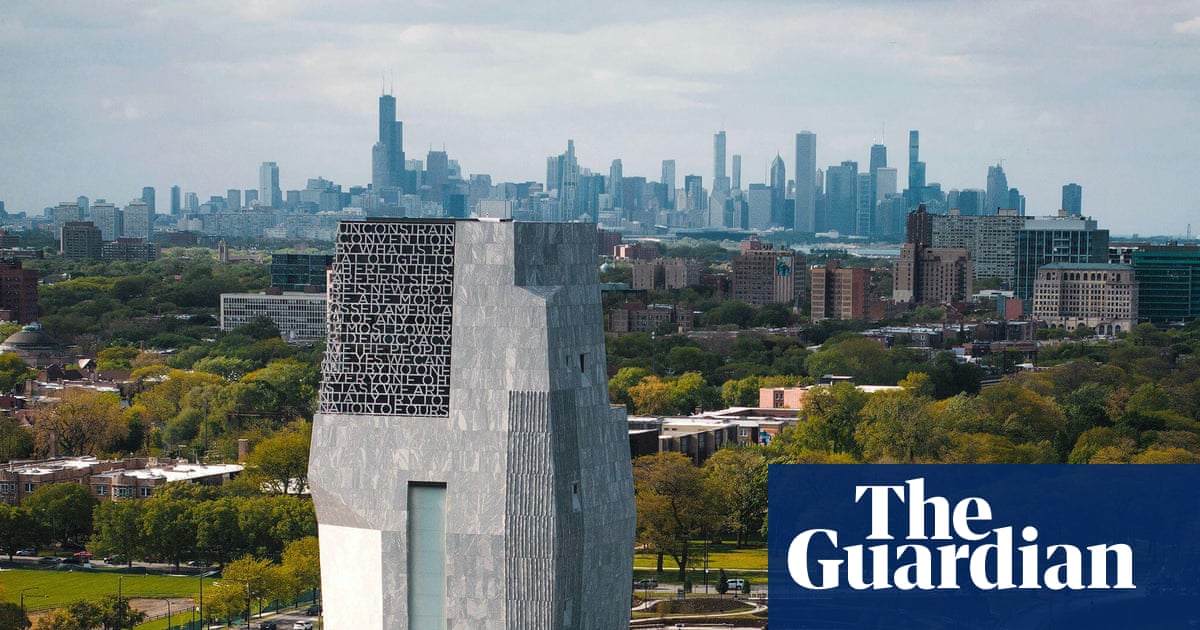
Rising above the low-rise, low-income neighborhood, the building has an ominous presence, its mostly windowless heft recalling a menacing sci-fi headquarters, with small chamfered openings suggesting portals from where drones might be launched, or lasers fired. Some have compared it to a flak tower, others to a “Klingon prison”. If it is a beacon of hope, it seems to be one that has been fortified at all costs, a defensive bunker to protect its fragile values from siege.
“The president was very, very hands on with the design,” says Tsien, with a rueful air. “When you have a client who says that, you get kind of uncomfortable,” admits Tsien. “It usually means they’ve got big opinions, and he definitely had big opinions."
She says the Obama Foundation, which runs the centre, “wanted something ‘iconic’ which isn’t how we’ve worked before. I don’t think you can design something to be iconic.” Her face falls when we encounter 3D-printed plastic models of the building for sale in the gift shop, priced at $40. Still, the client got what it wanted: this memorable menhir won’t be mistaken for anything else on your mantelpiece.
Inspiration also came from a rock that Tsien and Williams acquired on a trip to Ethiopia, of a similar faceted shape to the building, with letterforms carved across its surface. It only seemed fitting to wrap the facade with his words. The lines, from his speech commemorating the 50th anniversary of the marches from Selma to Montgomery, now form a sun-shading screen at the top of the tower’s south-west corner. “YOU ARE AMERICA,” you can just about make out, before the words dissolve into an illegible sea of letters. “I don’t know why it’s in Latin,” one confused local resident told me.
The tower is the most visible part of a vast four-building campus, wrought in blocky grey granite volumes, with bronze trimming and concrete interiors, lending the place a rather funereal air. There is a “forum”, housing an auditorium, gift shop, cafe and restaurant (where you can order an Obama burger or Michelle’s family chilli), and a branch of the Chicago Public Library, featuring a presidential reading room of Obama’s favorite books, where you can sit in his favourite Hans Wegner reading chair.
At some points, the Obamamania gets a bit much – there is even an Obama tulip variety in the garden.
Farther south, past an impressively equipped playground, sledging hill and bowl-shaped great lawn, is Home Court, a shiny aluminium-clad sports pavilion by Moody Nolan, the largest African American owned design firm in the US. It features an indoor NBA-spec basketball court, emblazoned with inspirational Obama-isms, like “Yes we can,” and “No one does big things alone” – a motto the foundation stood by in bringing another architect on board, when Williams and Tsien’s plan got too pricey, with not entirely happy results. The angular metal shed looks like a cheap afterthought.
It faces on to the sledging hill, which was originally to house a subterranean archive, until it was decided that this would be the first presidential library that wasn’t actually a library. (This may be why its official title is the Obama Presidential Center.) To the concern of some historians, Obama’s is the first entirely digital presidential archive, the centre run not by the National Archives, but by his own private foundation, raising concerns over its objectivity.
“We didn’t build it to celebrate my ability to bring about change,” Obama declares in a promotional video. “We did it to unlock yours."
The transformational change, he hopes, will happen inside the enigmatic tower where, for $30 a ticket, visitors are transported through four floors of an immersive, interactive Obama experience – a vertical Obamarama.
There is also a full-size recreation of the Oval Office,, where you can stand in line for a selfie at the Resolute desk. Other highlights include campaign memorabilia, from badges to custom Air Jordans.
An elevator finally whisks you past a private presidential suite to the “sky room” at the tower’s summit, where panoramic windows frame the city, beneath a momentous white pyramid-shaped ceiling – the pharaonic chamber at last! It was intended to have a celestial quality, with blue words by artist Idris Khan tumbling from the sky. But, in a major blunder, the pyramid doesn’t culminate in a skylight, but a solid white plasterboard ceiling.
The decision to build on a public park sparked furious lawsuits,
but the foundation insists that the project has resulted in more parkland and more trees, thanks to the removal of a road. Still, the symbolic land-grab struck a nerve, when there are so many vacant lots nearby.
Beyond the neighboring public housing, you can also see a clutch of new luxury apartment towers that have shot up in the last decade – a result of the Obama gentrification effect that local residents accurately feared the new center would bring. The project has fuelled a frenzy of land speculation, seeing rents rise and low-income tenants facing displacement, the center’s projected $3.1bn of economic uplift perhaps not reaching those who need it most.
Towering over a low-income area of Chicago, and wrapped in a speech that’s hard to decipher, this controversial monolith feels like a menacing sci-fi HQ. Is it a monument – or a mausoleum?

www.theguardian.com