The OP aside, the story actually has been making the rounds in academia.
To each his own of course. On this board, there is little discussion about anything other than Trump. But there is a lot that goes on outside of just him.
Academia has been facing a lot of challenges this decade. And while this happened in Britain, it's exactly what's been happening here as well.
John McWhorter summarizes it very well:
How Academia Created Jason Arday
The plagiarism scandal at Cambridge is a symptom of a deeper problem: academia’s willingness to accept intellectual mediocrity from black scholars in its self-seeking pursuit of virtue.
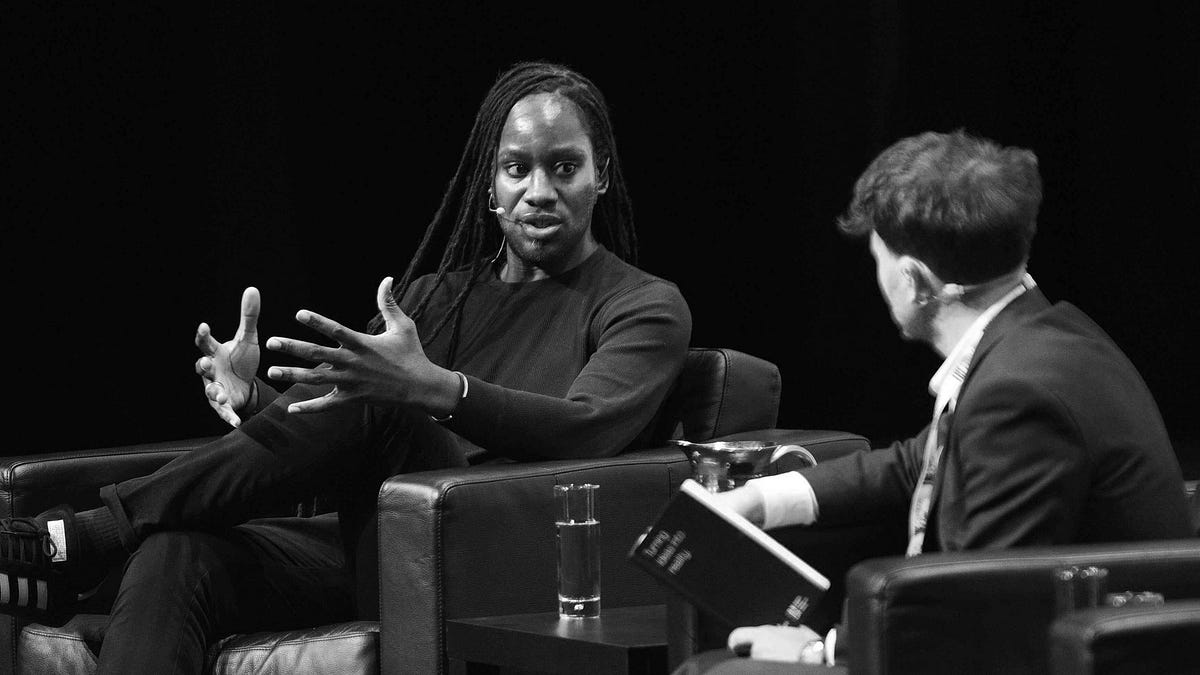
Jason Arday has a tell. Making what he considers important points, he holds his palms out and widens his eyes. Like many gestures, it conveys something beyond the statement itself—a silent way of saying, “Isn’t it obvious?” or “What else can I tell you?” It’s an assumption that all would agree with what he’s saying, but don’t for some reason (as in, racism, classism, ism-ism).
Whether it was his ridiculing an Australian television show for not depicting aborigines or contributing the insight that dissolving the monarchy would change the tax bracket of Britain’s working class, he often has the palms out, the eyes wide with wrinkled brow, the air of “Come on!” In my own teaching, I rarely fall into this conversational gesture. My job is presenting what is new to students, not pointing to what is supposedly obvious.
This alone encapsulated the flaw not only in Arday’s training and scholarship but the humanities and social science fields that celebrate people like him—a corrosive habit in academia, as Arday’s story of
fraudulent scholarship at Cambridge University, and his
subsequent resignation, have reminded us. Compared with some other examples of the genre, Arday’s mendacity and incompetence are especially stupefying. But he is nonetheless a symptom of academia’s dehumanization of black scholars and willingness to accept intellectual mediocrity in its self-seeking pursuit of virtue.
The main theme of Arday’s work is that racism is grievously determinative in the lives of black Britons; his PhD dissertation describes racism that black scholars must grapple with endlessly. In presentations, his manner, in his usual way, suggests that no decent person could disagree with this take, and that in a just world he wouldn’t even have to spell it out. Racism’s ubiquity and power is obvious, and anyone who questions this has an ulterior motive (maintaining power, inability to process The Other as fully human, etc.). In this, what Arday has in common with
Ibram Kendi is not just dreadlocks but an assumption that his view is one that everyone would share if not compromised by hatred of the subaltern.
The problem is that what is obvious is probably not very complicated—never mind that what Arday thinks is obvious is a vast and self-indulgent exaggeration. Within this mental universe, Arday’s academic focus was not on learning new things and fashioning new ways of processing existence but on criticizing others’ morals. This is not intellection but advocacy, and that is frankly much easier than thinking. The term
scholar-activist tries to finesse this by making the two appear to be alternate forms of the same endeavor. But the scholar-activist is often more activist than scholar, and Arday was an extreme example of the type.
Nothing in his work suggests intense engagement with a body of data (Arday himself has claimed that because of his dyslexia, he can engage only one page of academic prose in a sitting), or with a challenging way of analyzing that data. In academia, what is interesting is the counterintuitive, the discovery. Arday merely reinforced long-established and simplistic pieties. He became the equivalent of a full professor at Cambridge based on doing interviews with acquaintances about the racism they experienced, and then largely just presenting what they said. At its highest level, this could be good (but not great) journalism; it could not be academic work. On the level Arday worked, my 14-year-old could best him after some quick training in Latinate, Judith Butler-esque prose.
Arday was defrocked after the revelation that most of even this incurious nattering in the guise of research was plagiarized from others’ work. Claiming that his supposed autism made him think that learning was mimicry, he composed most of his work from generous tranches of cut-and-paste from other sources, often (but certainly not always) lightly reworded. But even if this performance art disguised as thought were all his own work, his elevation to such heights by Cambridge was an abomination.
As I might say (with palms out and widened eyes), arguing for the obvious is not brilliance. Even when it’s about black people.
Even worse than Arday’s work displaying no actual excellence is the consequence that characters like him wind up passing the torch to the next generation of black scholars. In a career spent in and around academia, I’ve seen this happen too many times. I refer to nothing like all black academics. But this is a vortex that young black scholars are sadly vulnerable to being pulled into, aided and abetted by white fellow travelers.
Especially if they have a certain stage presence, people like Arday attract mentees, who often value sitting at the feet of someone of their own race, who may understand their experiences more readily than other professors. But what happens when the Arday types don’t have anything actually to teach? Some of his former students are
demanding redress.
Arday had no original ideas. He can’t teach someone how to write because his writing consists of, well, “mimicry.” (Even his resignation letter seems likely to have been
generated by AI.) There are reports that—big surprise—Arday had no idea what actual teaching was and couldn’t be bothered with supervising students’ work, probably because he had never done any himself. People taught by versions of this type end up occupying an alternative academic universe, where cultural fellowship and advocacy are the North Star, and learning and curiosity get lip service but are beside the point.
When eager young black students gravitate to people like Arday, they learn that, for black academics, their race is more important than having anything to say. Sadly, white colleagues reinforce this by treating black academics this way at conferences and in hiring. One typical result: Carolyn Rouse being appointed president of the American Anthropological Association, despite her inability to answer civil but serious questions about charges of ideological takeover in her discipline with anything beyond verbal coleslaw. Arday was treated as brilliant for his self-involved, unfocused, underinformed drivel—and his resignation letter shows no awareness that anything was amiss about that.
The mentees, evangelized in the conviction that their blackness is what makes them matter rather than hard mental work, do not learn how to reason closely and clearly. And again, white academics make sure that they never have to. An eminent white academic once contacted me while on a committee evaluating a black scholar for a prestigious award, asking me what I thought of the person’s work. The truth was that the scholar’s writings and presentations were earnest but unstructured and unoriginal. From acquaintance, I knew that she could have done much better than this but simply had never been taught how. She was on the short list transparently because she was black. Many like her get the award nevertheless—and the torch passes on.
When eager young black students gravitate to people like Arday, they learn that, for black academics, their race is more important than having anything to say.
Their mentors never pose serious questions to them. (“Jason, are you sure this is really an instance of racism? Explain to me why you think so, and I will teach you to make the case before those who aren’t prepared to hear your claim.”) The relationship is instead about support, protection, understanding—never challenge. Thus, the mentee winds up thrown by and bristling at even polite, reasonable questions, of a kind that white academics consider integral to their profession. For real academics, having papers rejected is a virtual rite of passage and only makes their subsequent work better. But Arday characterized the rejection of his first article submissions as “violent.” For Arday, only racism could explain it; if his topic is racism, there can be no justified rejection. Kendi’s imperious pique at having his ideas questioned is in a similar vein. He can process the questions only as being aimed at him as a person (i.e., racism).
And make no mistake: The protests of Arday and his ilk arise not from their quietly feeling inferior to their white colleagues who do real work. They get praised to the skies for their advocacy couched in academic language. They come to think of the advocacy as equally sophisticated to learning, and even morally superior—Edward Said argued that scholarship alone was of little worth unless enlisted in a commitment to social justice—and white colleagues encourage them in this.
It reminds me of a warm, smart white linguist, a generation older, whom I knew in my early academic days. Many linguists’ work focuses on highly abstract conjectures about how we produce language, expressed in a jargon as ingrown as one would expect of a science. My academic work on language has been, if not almost as willfully opaque to normal people, quite wonky; few without a linguistics PhD (or something close) would get much out of most of it. This linguist assumed—not without reason—that as a black person, my interest in language must be about defending nonstandard speech such as black English. She told me not to worry if other linguists tarred my work as less intelligent, because “if what you’re committed to is telling your students the way they talk is okay, that’s fine.” She intended no insult. But telling people that disapproval of their speech is racist is not especially difficult. It is advocacy, rather than the glorious mental squint of trying to work out something complicated. It takes much less mental candlepower than delving into the details, often delightfully counterintuitive, about how languages become what they
The plagiarism scandal at Cambridge is a symptom of a deeper problem: academia’s willingness to accept intellectual mediocrity from black scholars in its self-seeking pursuit of virtue, writes John McWhorter.

www.thefp.com