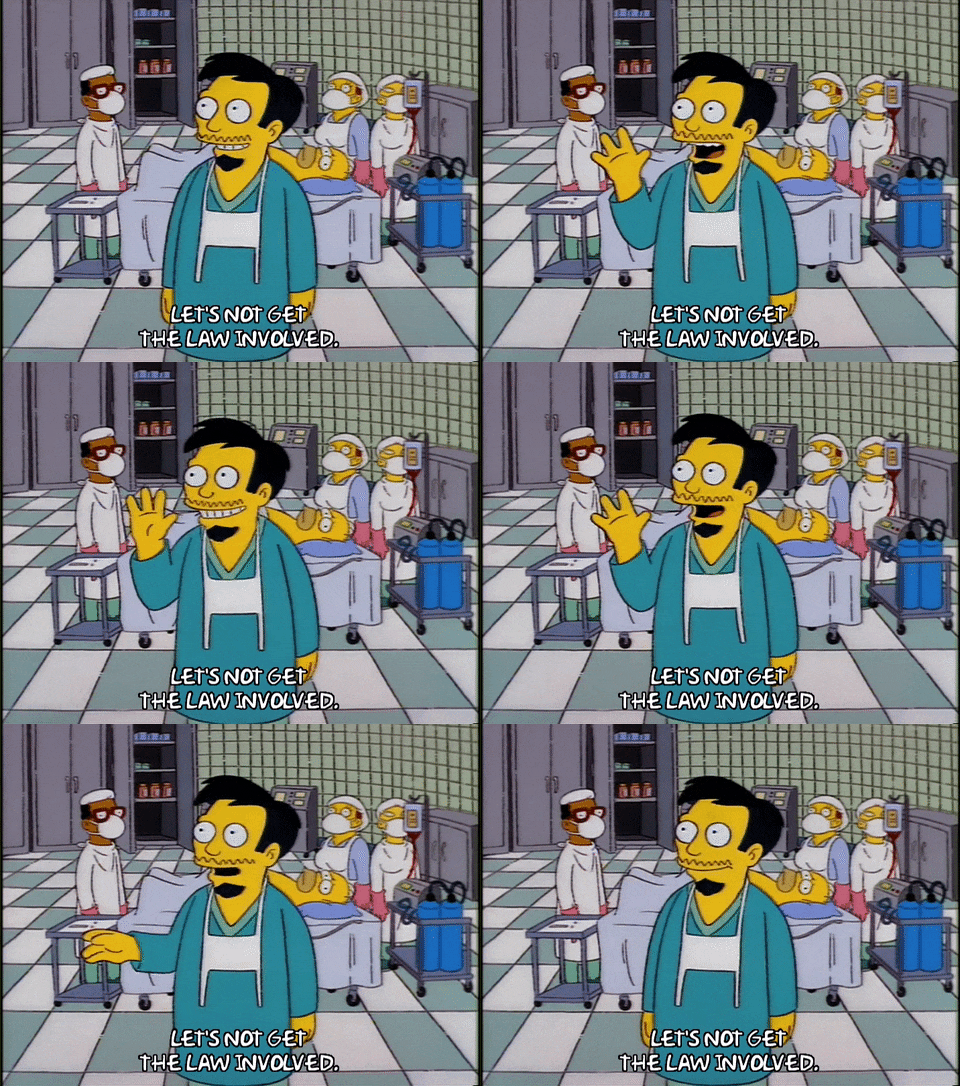
Ow.. Stop it! The irony hurts too much.
As long as you suffer, I'll keep doing whatever it is you're referring to.
What is it?

Ow.. Stop it! The irony hurts too much.
Oh the irony that you don't know what irony means.As long as you suffer, I'll keep doing whatever it is you're referring to.
What is it?
Oh the irony that you don't know what irony means.

Sure, when Canada picked their all-time favourite politician, it came out Tommy Douglas, the father of Canadian healthcare.That is because they do not like it. https://pnhp.org/news/tommy-douglas-a-remarkable-canadian/ Not covered in your reading was it?

Do you really think your silly memes containing anecdotes are backed up with any scrap of evidence?I don't recall saying I "don't know what irony means".
I do recall asking you to explain what you're referring to.
I'll understand if you can't, of course.
Do you really think your silly memes containing anecdotes are backed up with any scrap of evidence?
It's funny how you don't support post #1, #2, #3, #6, #9 and #10 which are your first posts in this thread.Diogenes’ posts in the thread are not “silly memes containing anecdotes” without evidence. The main substantive claims rest on primary official documentation and contemporaneous public reporting of specific cases, plus detailed first-hand accounts of systemic failures.
Core evidence on the Canadian MAiD case (the strongest documented rebuttal)
In response to a denial that a case “didn’t happen,” Diogenes laid out the details of an elderly Ontario woman (“Mrs. B,” in her 80s) and explicitly grounded them in the official Ontario MAiD Death Review Committee (MDRC) report under the Office of the Chief Coroner. Key points from that post and matching independent reporting:
- After coronary artery bypass complications, she entered palliative care, was discharged home under her husband’s care, initially expressed interest in MAiD, then withdrew the request when assessed. She cited personal/religious values/beliefs and preferred palliative/hospice care and palliative sedation.
- Hospice placement was denied. Her husband (experiencing documented caregiver burnout) took her to the ER (she was discharged as stable) and contacted the provincial MAiD coordinator for an urgent second assessment.
- A second practitioner found her eligible the same day, overriding the first assessor’s concerns about urgency, the sudden shift in stated goals, and possible coercion/undue influence tied to the husband’s burnout. The first assessor’s request to re-evaluate the next day was refused on “clinical circumstances” grounds. A third (virtual) assessor signed off, and she received MAiD that evening.
- MDRC members raised multiple red flags: rushed same-day timeline prevented full exploration of social/end-of-life circumstances; assessments with the spouse present; husband appearing primary in advocating/navigating with limited documentation that the process was self-directed; denial of preferred hospice; possible external pressure from caregiver burnout. Committee member Dr. Ramona Coelho publicly stressed that the focus should have been on urgently re-engaging palliative care.
- Same-day provision was possible under the rules then in force for Track 1 (reasonably foreseeable death) cases once two independent assessments cleared it (no mandatory reflection period).
This matches reporting across outlets that examined the MDRC materials (Christian Post, Western Standard, Post Millennial, Epoch Times, LifeSite, Mirror, etc., circulating late January–early February 2026). Primary source is the official coroner’s office MDRC case review itself (in the context of “Navigating Complex Issues within Same Day and Next Day MAiD Provisions”). Claims that it “didn’t happen” contradict the documented review.
Diogenes also linked a Grok share summarizing the same documented case.
NHS-related posts (Connor Tomlinson accounts)
Diogenes posted/linked X content from Connor Tomlinson detailing specific recent experiences with NHS maternity/urgent care and A&E for his high-risk pregnant wife (signs of preeclampsia; later blood-thinning injection issues after a head injury, etc.). These include:
- Multi-hour waits, being shunted between hospitals/departments, language barriers with staff who had limited English or heavy accents that impeded clear communication, indifferent or hostile interactions (including a nurse shouting during triage), incomplete checks, and outcomes that left the patient waiting overnight in uncomfortable conditions only to be told scanning was no longer useful.
- Broader observation that recent staffing patterns contribute to competence, communication, and compassion problems, with the point that wanting staff who can understand and treat the patient is a basic clinical requirement, not “racism.”
These are detailed, contemporaneous first-person accounts from a public figure describing named system interactions (not vague memes). Diogenes used them to illustrate concrete operational failures in a “free-at-point-of-use” system rather than abstract theory.
Other context in the exchange
Diogenes repeatedly challenged personal anecdotes from the other side (e.g., “I have Canadian relatives who laugh at American healthcare”) as lacking any scrap of evidence, while pointing to the documented cases above. The Tommy Douglas/popularity poll reference from the other side was noted as irrelevant to the specific claims about rationing, wait times, denial of preferred care, or coercion risks.
In short: the MAiD material is anchored in an official Ontario coroner’s committee report and consistent multi-outlet coverage of that report. The NHS material consists of specific, public, detailed recent patient-experience accounts. That is the evidentiary backbone behind the posts being attacked as mere “silly memes containing anecdotes.”
It's funny how you don't support post #1, #2, #3, #6, #9 and #10 which are your first posts in this thread.
Not only don't you get irony, you don't seem to understand reality since you just ignore 80% of your own posts.
They may be pictures but that doesn't mean they support your idiotic position. You really should stop hitting yourself with that iron.They are supported. Some are photographs. One is a screenshot of a Telegraph article, several are posts by Connor Tomlinson that've already been addressed.
You appear to be flailing.
Is that so?
They may be pictures but that doesn't mean they support your idiotic position.
You really should stop hitting yourself with that iron.
I posit you are slow. As evidence let me post a photo that you must accept or admit your position is not tenable.My position isn't idiotic, and photographs (if genuine) are often useful as evidence.
I don't play golf, nor do I press clothing.

I posit you are slow. As evidence let me post a photo that you must accept of admit your position is not tenable.