Texas Public School Students Will Be Required to Read the Bible

No Biblical reference supports such views.

  • Some denominations promote total abstinence (e.g., Southern Baptists, Methodists historically, Seventh-day Adventists, Salvation Army) as a wisdom choice or to avoid causing others to stumble (Romans 14:21), especially in cultures with alcoholism problems. This is often a disciplinary or cultural stance rather than a blanket biblical "forbid."
In short:
  • Core Christianity emphasizes self-control, sobriety of mind, modesty, and avoiding idolatry or addiction (1 Corinthians 6:12, 10:23).
  • Neither dancing nor moderate drinking is inherently sinful according to the Bible.
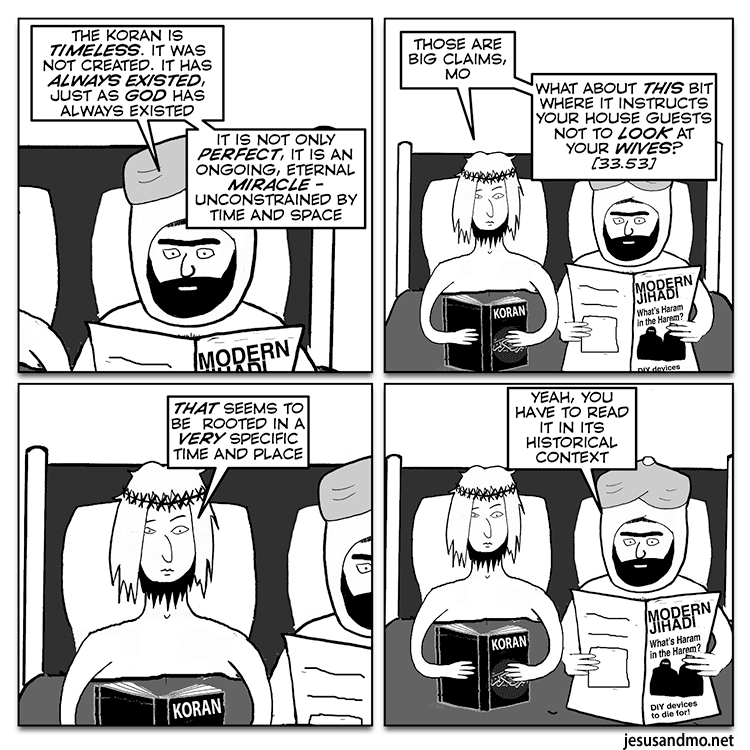
Precisely my point! You get a cookie! 🍪 People deviate from the teachings in their holy books.
 
But, depicting Mohammed, and using alcohol are both universally prohibited. Or...

context-1.png


Doesn't the Bible prohibit graven images? :dunno:
 
Deviation does not mean what you think it does.
"Yes, people can deviate from what they learned, as learning is influenced by various factors, including social environment and personal experiences. This deviation can occur when individuals encounter new information or contexts that challenge their previous understanding."
 
"Yes, people can deviate from what they learned, as learning is influenced by various factors, including social environment and personal experiences. This deviation can occur when individuals encounter new information or contexts that challenge their previous understanding."

Someone (Christiecrite) thinks that non-Biblical sectarian beliefs are "deviations". Aren't they simply non-foundational?

Yes, many "non-Biblical sectarian beliefs" are better described as non-foundational (or secondary/adiaphora) rather than automatic "deviations."


This touches on a classic tension in Christianity between sola scriptura (Scripture alone as the sole infallible rule) and broader views of authority. Here's a clear breakdown:


Foundational vs. Non-Foundational​


  • Foundational/core: Beliefs essential to historic Christianity, drawn directly from Scripture and affirmed across nearly all branches:
    • Trinity, divinity of Christ, resurrection, salvation by grace through faith, etc.
    • These are in the Bible and the early creeds (Apostles', Nicene).
  • Non-foundational/secondary: Practices, disciplines, interpretations, or developments not explicitly commanded or detailed in Scripture. Examples relevant to your prior question:
    • Strict prohibitions on dancing or all alcohol (beyond drunkenness).
    • Specific styles of worship, church government (episcopal, presbyterian, congregational), end-times views (premillennial, amillennial), spiritual gifts (cessationism vs. continuationism), fasting rules, etc.
    • These often arise from cultural context, prudential wisdom ("better safe than sorry"), or attempts to apply broad biblical principles (modesty, self-control, avoiding stumbling blocks).

Calling them "deviations" assumes a pure, Bible-only baseline from day one, with everything else as corruption. That's a strong sola scriptura perspective (common in some evangelical/fundamentalist circles), but it's not the only historic Christian view.


Why "deviations" is a strong claim​


  • The Bible itself doesn't operate in a vacuum. Early Christians relied on apostolic teaching, oral tradition, and church discernment alongside writings (2 Thessalonians 2:15; 1 Timothy 3:15 calls the Church the "pillar and foundation of the truth"). The canon of Scripture was discerned by the Church over centuries.
  • Development happens: Doctrines like the precise formulation of the Trinity were clarified at councils (Nicea 325, Chalcedon 451) using extra-biblical language to combat heresies. Protestants accept these but often reject later developments (e.g., certain Catholic Marian dogmas or papal infallibility).
  • Sectarian diversity is built-in: Denominations exist precisely because sincere believers interpret the same Bible differently on secondary issues. Paul addressed similar disputes (Romans 14 on food/days; meat sacrificed to idols). He urged unity on essentials while allowing liberty on disputables.
  • Every group has "extra-biblical" elements: Protestants have confessions/creeds (Westminster, Augsburg), worship styles, and traditions; Catholics/Orthodox emphasize apostolic succession and liturgy rooted in early practice.

Balanced perspective​


  • Not all non-explicit = deviation/error. Many are legitimate applications of wisdom, cultural adaptation, or "good and necessary consequence" from Scripture. Total rejection of them can lead to its own sectarianism (e.g., churches that forbid musical instruments because they're not mentioned in the New Testament).
  • Some are problematic: If a belief contradicts clear Scripture (e.g., denying resurrection) or adds requirements for salvation (legalism), it crosses into deviation or error. Prudential rules on alcohol/dancing can be wise pastorally without being universal law.

Christianity has always had both unity on the gospel and legitimate diversity on "how to live it out." Focusing on the foundational keeps perspective; treating every secondary practice as dangerous deviation often fuels unnecessary division.
A decent viewpoint, surprisingly.
 
What are you using to measure that comparison as the bible is "pretty violent" and sexually extreme.
If I were a HS kid, I'd be seeking out all the dirty parts to read in class.

Genesis 19:33-36
33 That night they got their father to drink wine, and the older daughter went in and slept with him. He was not aware of it when she lay down or when she got up.
34 The next day the older daughter said to the younger, “Last night I slept with my father. Let’s get him to drink wine again tonight, and you go in and sleep with him so we can preserve our family line through our father.” 35 So they got their father to drink wine that night also, and the younger daughter went in and slept with him. Again he was not aware of it when she lay down or when she got up.
36 So both of Lot’s daughters became pregnant by their father.


Ezekiel 23:3
3 3 They became prostitutes in Egypt, engaging in prostitution from their youth. In that land their breasts were fondled and their virgin bosoms caressed.

Isaiah 13:16 <--MAGAts will love this one!
Their little ones also will be dashed to pieces
Before their eyes;
Their houses will be plundered
And their wives raped.


Numbers 31:17-18 <---the White Nationalists will love this one since they like'em young!
17 Now kill all the boys. And kill every woman who has slept with a man,
18 but save for yourselves every girl who has never slept with a man.
 
  • Like
Reactions: QP!
Christianity does the same.
Agreed. Example below. Just because the MAGA morons, Trump's traitors and the White Nationalists cherry-pick what they choose to follow and ignore the rest doesn't negate what is in the Bible. All MAGAt are morons, demented and/or poorly educated. They don't realize that the Allah of the Muslims is the God of Abraham with the same rules.

1 Corinthians 11:3-16
5 But every woman who has her head uncovered while praying or prophesying disgraces her head, for she is one and the same as the woman whose head is shaved.
6 For if a woman does not cover her head, let her also have her hair cut off; but if it is disgraceful for a woman to have her hair cut off or
her head shaved, let her cover her head.

7 For a man ought not to have his head covered, since he is the image and glory of God; but the woman is the glory of man.
 
Doesn't the Bible prohibit graven images? :dunno:
yes, it does. This was a point of conflict between Protestants and Catholics because of Catholic "graven image" of the Virgin Mary. The fact Christ is often depicted on the cross in many Protestant denominations also violates the commandment. My church uses a plain wooden cross.

It's just more evidence the MAGA morons learn only certain parts of the Bible and shitcan the rest when it becomes inconvenient. This is why they elect liars, murderer and adulterers to be their leaders. They are all evil.

1782565663548.png1782565511104.png1782565575975.png1782565971427.png
 
Back
Top