Got a source that isn't horribly biased and uses some actual facts?
If the facts cited are incorrect, prove it.
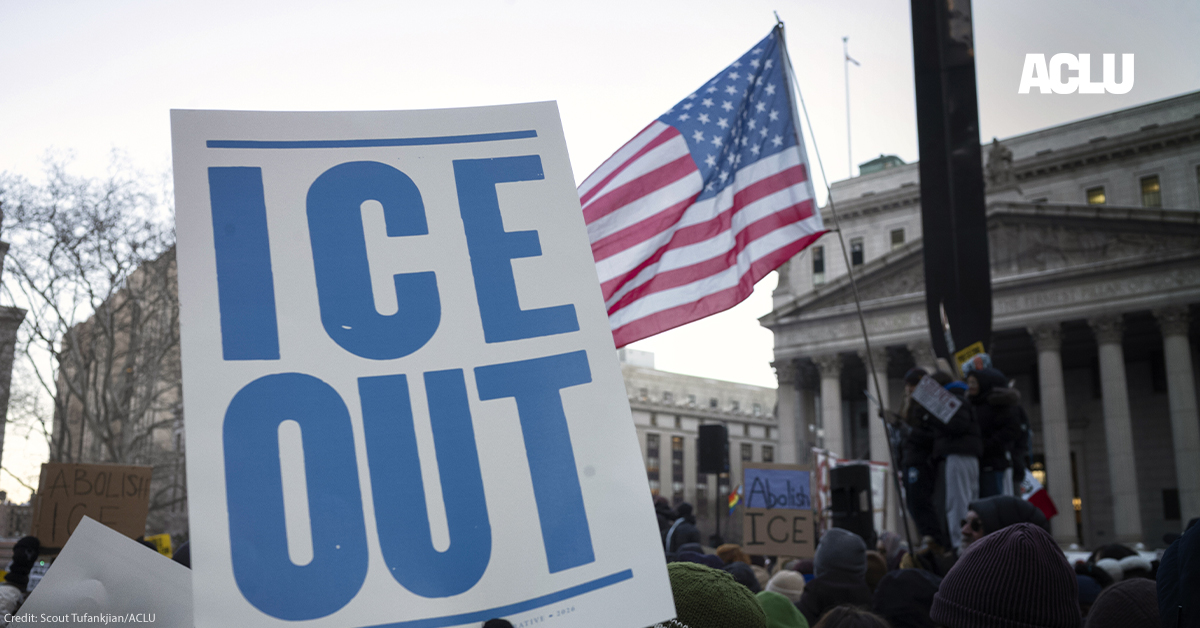
This ACLU piece (July 16, 2026) is an advocacy summary of the report
Agents of Chaos and Cruelty. It is not a census of ICE operations and not a court finding. It is a selected incident review used to argue that 2025 street enforcement was systematically abusive and that ICE should be replaced.
What they actually did
They reviewed
1,213 publicly reported incidents in eight states in 2025 (Arizona, California, Colorado, Florida, Illinois, Louisiana, Maryland, New Mexico). Sources were news, court filings, community alerts, videos, congressional material, and prior ACLU work. Single uncorroborated social-media posts were excluded. They coded who was affected, where actions happened, and tactics used.
They say they did
not start by hunting only for violations. In practice the sample is still news- and advocacy-driven. High-conflict street arrests, protests, and viral videos are far more likely to appear than routine jail transfers or quiet workplace arrests. They acknowledge this is “a small fraction” of 2025 enforcement. Hundreds of thousands of ICE arrests occurred that year; this set is a few thousandths of that activity.
“Misconduct” is defined broadly: use of force
or threatened force, intimidation,
or retaliation against people watching or filming. That is a civil-rights advocacy definition, not “found unlawful by a court.” “Likely racial profiling” (437 incidents) is an inference from who was stopped and how, not a proven equal-protection violation in each case.
Headline numbers, with the fine print
| Claim in the article | What it means |
|---|
| 1,200+ actions | Publicly documented incidents in 8 states, not all ICE actions nationwide |
| 432 incidents with “misconduct” | Force, threat of force, intimidation, or retaliation against observers — about 1 in 3 of this sample |
| 437 “likely” racial profiling | Coded judgment, not adjudicated |
| 624 everyday locations | Grocery stores, bus stops, gas stations, sidewalks, highways — consistent with a shift to street/community arrests |
| 418 push/shove/tackle/pin; 81 neck/breathing tactics; 361 chemical irritants | Counts inside the selected incidents, not rates per arrest |
| 214 children (32 U.S. citizens); 155 U.S. citizens; 782 protesters/journalists/officials/clergy/observers | Includes people present, targeted, or “subjected to misconduct,” not only people taken into custody |
| 49 actions at/near schools, 40 lockdowns | “Near” is elastic; still a serious category if the underlying reports hold |
Several specific vignettes (Hyattsville gun drop, Simi Valley rolling SUV, Bowie minivan stop with kids in the back) are offered as illustrations. Those are individual case narratives. They can be true and still not prove a nationwide rate.
What holds up
Volume and mix of arrests changed. Independent data — not ACLU — show interior arrests rose sharply in 2025 and the share of arrestees with criminal
convictions fell as volume rose. Figures vary by source and definition:
- CBS, using an internal DHS document: ~393,000 ICE arrests in the first year of the second term; nearly 40% with no criminal record; under 14% with violent charges or convictions.
- Deportation Data Project / academic work: community arrests up sharply; conviction share among book-ins fell toward the high-20s to mid-30s percent range at points in 2025–26.
- Cato’s read of leaked ICE booking data (late 2025): a large majority of that snapshot had no conviction; violent convictions were a small slice.
So the article’s core political point — “worst of the worst” rhetoric does not match the arrest mix at this scale — is directionally supported by government and academic numbers. Illegal presence is a civil violation for most people in this pool; that is not the same as “no law was broken,” but it is also not the public-safety framing used in speeches.
Street enforcement in ordinary places increased. That is a real operational shift: more community arrests, more 287(g)/local partners, more visible stops. Collateral encounters with citizens, kids, and bystanders follow from that method. That does not automatically make every encounter unconstitutional.
Use-of-force and protest clashes are real categories of risk. Rapid hiring, shorter training (the report claims standards were cut), quotas, masks, unmarked cars, and crowd-control munitions raise the chance of sloppy or excessive force. Isolated fatal shootings in 2025–26 are part of the public record the ACLU is folding into a pattern argument. Pattern vs. rate is the issue they do not resolve.
What is weak or overstated
Selection bias. Searching news + rights networks + protest coverage will find chaos. It will undercount uneventful arrests of people with final orders or criminal convictions. You cannot treat “1 in 3 of our 1,213 incidents involved misconduct” as “1 in 3 ICE actions nationwide.”
Loaded framing. “National deportation policing force,” “authoritarian playbook,” “white supremacist recruitment,” “no one is safe,” “changing the nature of American life” are persuasion, not measurement. Recruitment-ad controversies and political rhetoric exist; they do not convert every traffic-stop arrest into a regime-change story.
Category inflation. Counting every protester, journalist, or observer “targeted or subjected to misconduct” in group events produces a large 782 figure. Crowd-control against people interfering with an arrest is legally different from randomly snatching bystanders. The article blurs that.
Citizens and children. Wrongful detention of citizens is a serious, documentable problem when it happens. The 155 / 214 counts mix detention, presence, and “misconduct.” A U.S.-citizen child in a car during a parent’s arrest is not the same event as ICE locking up that child.
Causal leap to “blueprint for authoritarian rule.” Mass interior enforcement, 287(g), courthouse arrests, and ending sensitive-location limits are policy choices with civil-liberties costs. Calling them a planned authoritarian template is an inference the data do not prove.
Policy payload. The article’s destination is explicit: replace ICE with a “service-oriented” Immigration Management Agency, pass a path to citizenship (they cite ~4.4 million via Dream and Promise-style bills), kill 287(g), and claw back large enforcement appropriations. That is a political program. The incident catalog is assembled to support it.
How to use this as a reader
Treat it as
a large annotated clip file of ugly or contested encounters, useful for asking: Are street tactics, masks, chemical agents, and school-adjacent operations becoming routine? Are citizens being swept in? Is the criminal-alien claim oversold?
Do
not treat it as:
- a statistically representative audit of ICE,
- proof that half of all operations are illegal,
- proof that enforcement itself is illegitimate, or
- a substitute for case-by-case video, charging documents, and use-of-force reviews.
The strongest empirical claim in the package is the one ACLU leans on least carefully as a
rate: when ICE scales community arrests to meet volume goals, the pool tilts toward people with no or weak criminal records, and messy public encounters multiply. That is supported outside ACLU. The weakest claim is the one they lean on hardest: that this selected set demonstrates a unique, nationwide culture of cruelty that can only be fixed by abolishing the agency. That is argument, not demonstrated frequency.


 Get your head out of Trump's ass and watch more than Fox News and it's cousins: