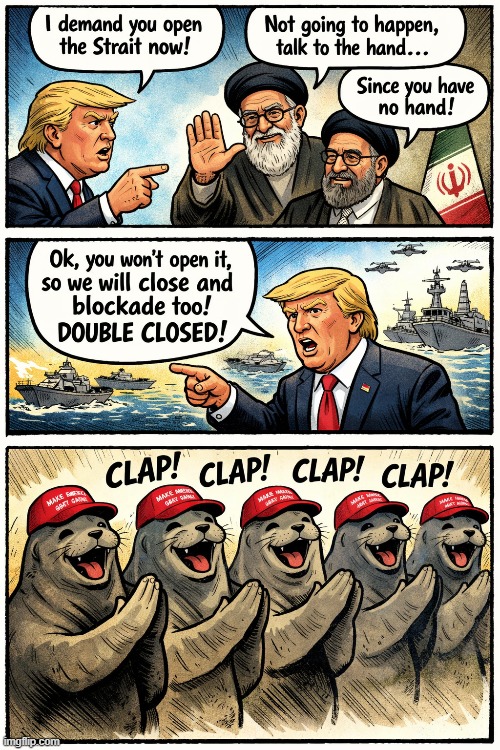
Can you believe that JPP marxists thought Iran could control Strait of Hormuz?

Seriously. How do these board marxists led by board troll Jarod hate this country that they would believe Iran could control and dictate the Strait of Hormuz.

Their military has been decapitated and decimated and they don’t have the resources to do it.

Trump would never let it happen. Yet here they are believing it.

Look at all of those Strait of Hormuz threads that now just died on the vine

Poor marxists. When will they learn?

As happens with people unable to think clearly, observations of a singular event are considered, and in this case idiotically lampooned as, claims of a fixed state of being.
 
Seriously. How do these board marxists led by board troll Jarod hate this country that they would believe Iran could control and dictate the Strait of Hormuz.

Their military has been decapitated and decimated and they don’t have the resources to do it.

Trump would never let it happen. Yet here they are believing it.

Look at all of those Strait of Hormuz threads that now just died on the vine

Poor marxists. When will they learn?
I can believe it. I just saw Jarod's brain-dead comment right below your post. He represents the JPP Marxist quite well.
 
They did for a few days. At the same time, Trump said he didn’t care if they did.

I think the broad truth is that neither side can keep it open without the other side agreeing. It might open for a few days, we will see. That has not happened yet.

A lot of experts say it cannot be held open Safely for a long period of time without Iran, ceasing to attack ships passing through. It might be technically reversible, but not economically feasible. I guess we’ll see.
JaRod's comment is a perfect example of why the answer to the question in the thread title is, YES, I can believe it. JaRod represents the typical moron on the left perfectly. Obviously, his comment is as dumb as any other out there in libtard land.

But I really love the last part: 'A lot of experts say....' I challenge Jarod to name a couple of these 'experts' and what they are saying today. It highlights how morons are exploited over and over, day after day, year after year.

I will guarantee that if Jarod actually names one of his 'experts,' I won't be able to find a single prediction or claim from this expert that has been correct or even close to correct, ever. I mean not once. They never are, but it doesn't matter to a libtard. It's what they want to hear that matters more than anything.

If the expert chimes in at the appropriate time with the predetermined narrative, they get the job. Again, it only matters if they have the right message. These days, the message is always anti-American, anti-Trump, and anti-Trump supporter, period. Anything other than that is largely ignored.

Again, it's message over reality. It's symbolism over substance. It's how it sounds, how it looks, and how it measures up to the woke ideology required to stay part of the club.

Jarod is just a useful idiot. He can't help himself. A drone only follows its programming, period.
 
I don't believe he is a lawyer for a couple of reasons

1) he spends ALL of his time here. Clearly he doesn't work, at least not the kind of hours a successful lawyer would work
2) His grammar and writing suck. It is barely above elementary school level
3) His spelling sucks. He wouldn't make it out of a 1st grade spelling bee

No way he is a lawyer. Maybe he works in a law office as a janitor?
Ooh ooh ooh, can I play?
I don't believe she was a teacher for a couple of reasons

1) she spends ALL of her time here. Clearly she didn't work, at least not the kind of hours she claims she donates to all the benevolent causes on the earth
2) Her grammar and writing suck. It is barely above elementary school level
3) Her spelling sucks. She wouldn't make it out of a 1st grade spelling bee

No way she was a teacher. She might have worked in a school as a janitor.
Did I do it right? @ThatOwlWoman? :ROFLMAO:
 
JaRod's comment is a perfect example of why the answer to the question in the thread title is, YES, I can believe it. JaRod represents the typical moron on the left perfectly. Obviously, his comment is as dumb as any other out there in libtard land.

But I really love the last part: 'A lot of experts say....' I challenge Jarod to name a couple of these 'experts' and what they are saying today. It highlights how morons are exploited over and over, day after day, year after year.

I will guarantee that if Jarod actually names one of his 'experts,' I won't be able to find a single prediction or claim from this expert that has been correct or even close to correct, ever. I mean not once. They never are, but it doesn't matter to a libtard. It's what they want to hear that matters more than anything.

If the expert chimes in at the appropriate time with the predetermined narrative, they get the job. Again, it only matters if they have the right message. These days, the message is always anti-American, anti-Trump, and anti-Trump supporter, period. Anything other than that is largely ignored.

Again, it's message over reality. It's symbolism over substance. It's how it sounds, how it looks, and how it measures up to the woke ideology required to stay part of the club.

Jarod is just a useful idiot. He can't help himself. A drone only follows its programming, period.
From AI...

Experts and Analysts Expressing Doubt That the U.S. Can Unilaterally Open the Strait While Iran Resists​


1. Maria Sultan — Director General, South Asian Strategic Stability Institute (Pakistan)


Speaking directly to Al Jazeera, Sultan said that if U.S. ships had moved freely through the strait, it would have had to have been with Tehran's permission. "So understand, [if] Iranians do not give a safe passage, it's impossible for the American military fleet to move freely in the Strait of Hormuz." Al Jazeera This is perhaps the most direct statement of the core thesis — blunt, from a credentialed strategic analyst in a country actively hosting the negotiations.


2. Andreas Krieg — Senior Lecturer, King's College London (School of Security Studies)


Krieg called the enforcement of a U.S. blockade "a complicated, 'high-risk' and legally contentious endeavor." He said it would "look less like a clean historical blockade and more like a messy, high-risk interdiction regime," requiring the U.S. to "identify, track, hail, divert and maybe even board vessels linked to Iranian ports, all while 'operating in one of the most crowded and politically sensitive waterways in the world.'" NBC News


3. Yu Jihoon — Research Fellow, Korea Institute for Defense Analyses (former South Korean submarine officer)


Yu called the blockade "high risk" because of Iranian options to strike back — including mines, small boats carrying missiles, surface drones, aerial drones, land-based cruise missiles, and shoulder-fired anti-aircraft missiles. He warned that "if Iran accepts it as a violation of its sovereignty or a de facto expansion of maritime warfare, the possibility of a local military conflict could increase." CNN


4. Jennifer Parker — Nonresident Fellow, Lowy Institute (former Royal Australian Navy officer)


Parker explained that reopening the strait requires multiple layered military operations: a prior bombing campaign to reduce threats from Iran's coastline, persistent airborne surveillance, combat air patrols over the strait and Gulf, warship escorts, and — critically — an "extensive and time-consuming mine clearance operation" if mines are confirmed or even suspected. She underscored that Iran dominates the northern Persian Gulf, the Strait, and the Gulf of Oman geographically. The Conversation


5. Carl Schuster — Analyst, former U.S. Navy Captain


Schuster acknowledged that blocking off Iranian ports would be "procedurally difficult but practical if the US has maritime superiority" — then immediately qualified that maritime superiority "may not be the case," given Iran's multi-layered asymmetric arsenal. CNN The conditional is the point. He's essentially saying the predicate condition for success is itself in doubt.


6. Trita Parsi — Executive Vice President, Quincy Institute for Responsible Statecraft


Parsi warned that a full blockade would drive oil prices to around $150 per barrel by removing the only oil currently exiting the Persian Gulf. He also doubted Trump's resolve to push to full escalation: "I doubt Trump is ready for that escalation," and said it "wouldn't be surprising" if Trump walked back on his threats. CNBC Parsi's implicit argument is that the costs of forcing the issue are so severe that U.S. political will cannot sustain it.


7. The Mine Gap Problem — FPRI Analysts and Naval Experts (unnamed, multiple sources)


Experts have described a U.S. "mine gap" — the result of institutional neglect that led to the retirement of dedicated mine countermeasure vessels. Iran's stockpile is estimated at 2,000 to 6,000 mines, and analysts at the Washington Institute for Near East Policy noted that Iranian mine placement was likely strategically calculated to exploit the geography of the Gulf, forcing international traffic into narrow, vulnerable channels. Al Jazeera


Compounding the irony: new reporting suggests Iran mined the Strait haphazardly, failed to record mine locations, and now lacks the capacity to conduct effective clearance operations itself. Until those mines are found and removed, the Strait is practically closed — regardless of who controls the water above. Just Security


8. The Legal Dimension — "Emons" (cited in CNBC)


A legal expert identified as Emons stated flatly: "Under international law, specifically the rules governing international straits, the U.S. has no legal authority to close, suspend, or impede transit passage through Hormuz." Only Iran and Oman are coastal states, and even they are prohibited from suspending transit passage. CNBC The legal argument cuts both ways — against Iran's toll regime and against a U.S. unilateral blockade.


Seriously. How do these board marxists led by board troll Jarod hate this country that they would believe Iran could control and dictate the Strait of Hormuz.

Their military has been decapitated and decimated and they don’t have the resources to do it.

Trump would never let it happen. Yet here they are believing it.

Look at all of those Strait of Hormuz threads that now just died on the vine

Poor marxists. When will they learn?
Is that you Archie Bunker?!
 
Seriously. How do these board marxists led by board troll Jarod hate this country that they would believe Iran could control and dictate the Strait of Hormuz.

Their military has been decapitated and decimated and they don’t have the resources to do it.

Trump would never let it happen. Yet here they are believing it.

Look at all of those Strait of Hormuz threads that now just died on the vine

Poor marxists. When will they learn?
Ah, Iran is controlling the Straits, even with Trump’s blockage, if they weren’t why is it suddenly top priority of Trump to open the Straits, duh
 
  • Like
Reactions: QP!
From AI...

Experts and Analysts Expressing Doubt That the U.S. Can Unilaterally Open the Strait While Iran Resists​


1. Maria Sultan — Director General, South Asian Strategic Stability Institute (Pakistan)


Speaking directly to Al Jazeera, Sultan said that if U.S. ships had moved freely through the strait, it would have had to have been with Tehran's permission. "So understand, [if] Iranians do not give a safe passage, it's impossible for the American military fleet to move freely in the Strait of Hormuz." Al Jazeera This is perhaps the most direct statement of the core thesis — blunt, from a credentialed strategic analyst in a country actively hosting the negotiations.


2. Andreas Krieg — Senior Lecturer, King's College London (School of Security Studies)


Krieg called the enforcement of a U.S. blockade "a complicated, 'high-risk' and legally contentious endeavor." He said it would "look less like a clean historical blockade and more like a messy, high-risk interdiction regime," requiring the U.S. to "identify, track, hail, divert and maybe even board vessels linked to Iranian ports, all while 'operating in one of the most crowded and politically sensitive waterways in the world.'" NBC News


3. Yu Jihoon — Research Fellow, Korea Institute for Defense Analyses (former South Korean submarine officer)


Yu called the blockade "high risk" because of Iranian options to strike back — including mines, small boats carrying missiles, surface drones, aerial drones, land-based cruise missiles, and shoulder-fired anti-aircraft missiles. He warned that "if Iran accepts it as a violation of its sovereignty or a de facto expansion of maritime warfare, the possibility of a local military conflict could increase." CNN


4. Jennifer Parker — Nonresident Fellow, Lowy Institute (former Royal Australian Navy officer)


Parker explained that reopening the strait requires multiple layered military operations: a prior bombing campaign to reduce threats from Iran's coastline, persistent airborne surveillance, combat air patrols over the strait and Gulf, warship escorts, and — critically — an "extensive and time-consuming mine clearance operation" if mines are confirmed or even suspected. She underscored that Iran dominates the northern Persian Gulf, the Strait, and the Gulf of Oman geographically. The Conversation


5. Carl Schuster — Analyst, former U.S. Navy Captain


Schuster acknowledged that blocking off Iranian ports would be "procedurally difficult but practical if the US has maritime superiority" — then immediately qualified that maritime superiority "may not be the case," given Iran's multi-layered asymmetric arsenal. CNN The conditional is the point. He's essentially saying the predicate condition for success is itself in doubt.


6. Trita Parsi — Executive Vice President, Quincy Institute for Responsible Statecraft


Parsi warned that a full blockade would drive oil prices to around $150 per barrel by removing the only oil currently exiting the Persian Gulf. He also doubted Trump's resolve to push to full escalation: "I doubt Trump is ready for that escalation," and said it "wouldn't be surprising" if Trump walked back on his threats. CNBC Parsi's implicit argument is that the costs of forcing the issue are so severe that U.S. political will cannot sustain it.


7. The Mine Gap Problem — FPRI Analysts and Naval Experts (unnamed, multiple sources)


Experts have described a U.S. "mine gap" — the result of institutional neglect that led to the retirement of dedicated mine countermeasure vessels. Iran's stockpile is estimated at 2,000 to 6,000 mines, and analysts at the Washington Institute for Near East Policy noted that Iranian mine placement was likely strategically calculated to exploit the geography of the Gulf, forcing international traffic into narrow, vulnerable channels. Al Jazeera


Compounding the irony: new reporting suggests Iran mined the Strait haphazardly, failed to record mine locations, and now lacks the capacity to conduct effective clearance operations itself. Until those mines are found and removed, the Strait is practically closed — regardless of who controls the water above. Just Security


8. The Legal Dimension — "Emons" (cited in CNBC)


A legal expert identified as Emons stated flatly: "Under international law, specifically the rules governing international straits, the U.S. has no legal authority to close, suspend, or impede transit passage through Hormuz." Only Iran and Oman are coastal states, and even they are prohibited from suspending transit passage. CNBC The legal argument cuts both ways — against Iran's toll regime and against a U.S. unilateral blockade.


A perfect example of a bunch of morons that haven't ever been right about anything, not once. Thanks for sharing.
 
Look at all of the marxists backtracking now.

Too funny
that is not the issue.

Iran did effectively close the Strait. Trump demanded and screamed they need to open it or he would wipe out their entire civilization and they laughed in his face and ignored him so he switched to this.

aozz7n.jpg
 
And yes it was so effectively closed this is just one example in one country of the down stream effects of Iran closing it, which has required them too call in the military to help with rioting issues over diesel and gas, which i know of.


AI Overview


As of April 2026, the Irish government has deployed the Defence Forces to assist the Gardaí (police) in clearing blockades at key fuel depots and critical infrastructure.

Key Details of the Situation:
  • Cause of Protests: Nationwide protests were initiated by farmers, hauliers, and contractors due to soaring fuel prices, which reached over €2 per liter for diesel and nearly €1.90 for petrol, largely caused by conflict in the Middle East affecting global supplies.
  • Military Involvement: The government requested military assistance on April 9th, 2026, to remove heavy vehicles (tractors, trucks) blocking critical infrastructure like the Whitegate oil refinery in County Cork and Foynes Port in Limerick.
  • Government Stance: Justice Minister Jim O'Callaghan described the blockades as an unacceptable interference in critical infrastructure and instructed owners to remove their vehicles or risk them being damaged during removal by the military. Taoiseach Micheál Martin labeled the blockading of oil refineries an "act of national sabotage".
  • Impact: Over a third of gas stations in the Republic were reported to be running dry due to the blockades.
The military assistance is focused on providing heavy-lift recovery vehicles to remove obstructions rather than direct intervention against protesters themselves.
 
If you believe in what an incompetent and psychotic POS the likes of Crazy Trump preaches, then you're in for a big disappointment.
Speaking of preaching, TACO didn't go to sleep last night so he could portray himself as Jesus Christ on social media.

What an unbelievable, unserious fucking loser.
 
They did for a few days. At the same time, Trump said he didn’t care if they did.

I think the broad truth is that neither side can keep it open without the other side agreeing. It might open for a few days, we will see. That has not happened yet.

A lot of experts say it cannot be held open Safely for a long period of time without Iran, ceasing to attack ships passing through. It might be technically reversible, but not economically feasible. I guess we’ll see.
Iran can no longer attack ships, Pretender.
 
Back
Top