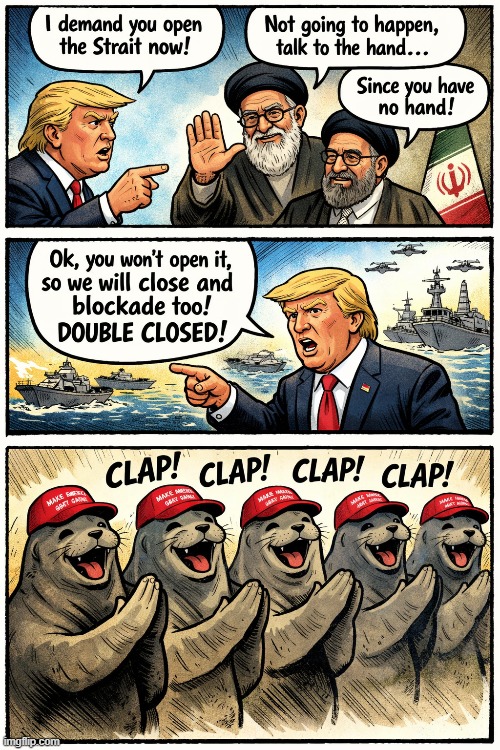
From AI...
Experts and Analysts Expressing Doubt That the U.S. Can Unilaterally Open the Strait While Iran Resists
1. Maria Sultan — Director General, South Asian Strategic Stability Institute (Pakistan)
Speaking directly to Al Jazeera, Sultan said that if U.S. ships had moved freely through the strait, it would have had to have been with Tehran's permission. "So understand, [if] Iranians do not give a safe passage, it's impossible for the American military fleet to move freely in the Strait of Hormuz."
Al Jazeera This is perhaps the most direct statement of the core thesis — blunt, from a credentialed strategic analyst in a country actively hosting the negotiations.
2. Andreas Krieg — Senior Lecturer, King's College London (School of Security Studies)
Krieg called the enforcement of a U.S. blockade "a complicated, 'high-risk' and legally contentious endeavor." He said it would "look less like a clean historical blockade and more like a messy, high-risk interdiction regime," requiring the U.S. to "identify, track, hail, divert and maybe even board vessels linked to Iranian ports, all while 'operating in one of the most crowded and politically sensitive waterways in the world.'"
NBC News
3. Yu Jihoon — Research Fellow, Korea Institute for Defense Analyses (former South Korean submarine officer)
Yu called the blockade "high risk" because of Iranian options to strike back — including mines, small boats carrying missiles, surface drones, aerial drones, land-based cruise missiles, and shoulder-fired anti-aircraft missiles. He warned that "if Iran accepts it as a violation of its sovereignty or a de facto expansion of maritime warfare, the possibility of a local military conflict could increase."
CNN
4. Jennifer Parker — Nonresident Fellow, Lowy Institute (former Royal Australian Navy officer)
Parker explained that reopening the strait requires multiple layered military operations: a prior bombing campaign to reduce threats from Iran's coastline, persistent airborne surveillance, combat air patrols over the strait and Gulf, warship escorts, and — critically — an "extensive and time-consuming mine clearance operation" if mines are confirmed or even suspected. She underscored that Iran dominates the northern Persian Gulf, the Strait, and the Gulf of Oman geographically.
The Conversation
5. Carl Schuster — Analyst, former U.S. Navy Captain
Schuster acknowledged that blocking off Iranian ports would be "procedurally difficult but practical if the US has maritime superiority" — then immediately qualified that maritime superiority "may not be the case," given Iran's multi-layered asymmetric arsenal.
CNN The conditional is the point. He's essentially saying the predicate condition for success is itself in doubt.
6. Trita Parsi — Executive Vice President, Quincy Institute for Responsible Statecraft
Parsi warned that a full blockade would drive oil prices to around $150 per barrel by removing the only oil currently exiting the Persian Gulf. He also doubted Trump's resolve to push to full escalation: "I doubt Trump is ready for that escalation," and said it "wouldn't be surprising" if Trump walked back on his threats.
CNBC Parsi's implicit argument is that the costs of forcing the issue are so severe that U.S. political will cannot sustain it.
7. The Mine Gap Problem — FPRI Analysts and Naval Experts (unnamed, multiple sources)
Experts have described a U.S. "mine gap" — the result of institutional neglect that led to the retirement of dedicated mine countermeasure vessels. Iran's stockpile is estimated at 2,000 to 6,000 mines, and analysts at the Washington Institute for Near East Policy noted that Iranian mine placement was likely strategically calculated to exploit the geography of the Gulf, forcing international traffic into narrow, vulnerable channels.
Al Jazeera
Compounding the irony: new reporting suggests Iran mined the Strait haphazardly, failed to record mine locations, and now lacks the capacity to conduct effective clearance operations itself. Until those mines are found and removed, the Strait is practically closed — regardless of who controls the water above.
Just Security
8. The Legal Dimension — "Emons" (cited in CNBC)
A legal expert identified as Emons stated flatly: "Under international law, specifically the rules governing international straits, the U.S. has no legal authority to close, suspend, or impede transit passage through Hormuz." Only Iran and Oman are coastal states, and even they are prohibited from suspending transit passage.
CNBC The legal argument cuts both ways — against Iran's toll regime
and against a U.S. unilateral blockade.