Mussolini made the Vatican into a nation.The Catholic Church in the 1900's was very right wing.

You are using an out of date browser. It may not display this or other websites correctly.
You should upgrade or use an alternative browser.
You should upgrade or use an alternative browser.
Hitler was on the Right side of the spectrum. . .
- Thread starter Jarod
- Start date

T. A. Gardner
Serial Thread Killer
I gave evidence. I did so by defining terms and applying them in a consistent fashion.You gave no evidence, you just gave your personal definitions.
Here's an example of the stupidity of what you are arguing commonly found on the internet and even in academia.
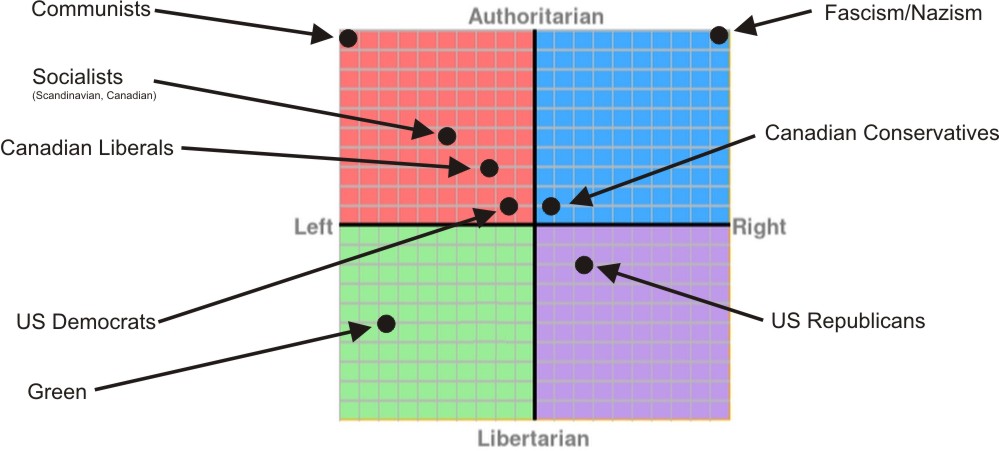
Four terms define the graph. Define those terms.
Here someone tries to make this graph a bit more defined, largely unsuccessfully.
None of these is internally consistent.
My graph has three axis:
Degree of government control: Goes from Anarchy (on the Right) or no government whatsoever to Dictatorship where one person rules everything (on the Left).
Form of economic system: Goes from Barter (on the Right) where there is no organized system of economics to Command Economy where everything is controlled by a central body or even a single person (the Left).
Degree of personal freedom: Goes from the Individual (on the Right) where everybody gets to make their own rules to Society / the Collective where individuals are subsumed into the greater body of society and have no freedoms to decide anything.
Everything politically, economically, and socially fall somewhere between those two extremes. That is a measurable and quantifiable system.
What you keep spouting is gibberish and unmeasurable and unquantifiable terms used at almost random.
T. A. Gardner
Serial Thread Killer
Let me finish that for youIf all historians are wrong,
...then all historians are wrong.
If you restrict this to actual historians who have explicitly argued that Hitler/National Socialism belonged on the left, rather than just saying Nazism had some socialist features, there are several examples:
- Joachim Fest — one of Germany’s best-known Hitler biographers. In a 2003 essay titled Was Adolf Hitler ein Linker? (“Was Adolf Hitler a Leftist?”), Fest wrote that there were “good reasons” to place National Socialism “on the left rather than the right politically,” and argued that Hitler’s system had more in common with Stalin’s totalitarianism than Mussolini’s fascism.
- Arnulf Baring — German historian, political scientist, and professor at the Free University of Berlin. In a 2011 television discussion he said explicitly: “The Nazis were not right-wing, the Nazis were a left-wing party.”
- Rainer Zitelmann — German historian whose doctoral work examined Hitler’s political and economic worldview. In his scholarly article The Role of Anti-Capitalism in Hitler’s World View, he writes that Hitler “was on the left of the political spectrum” before joining the German Workers’ Party and argues that Hitler increasingly favored planned economics over the market.
- Sebastian Haffner — German historian and author of The Meaning of Hitler. Haffner wrote that Hitler “stood on the Left” from the perspective of Germany’s conservative opposition, and went further: Hitler could not simply be placed on the extreme right; several fundamental features of his regime were, in Haffner’s words, “Leftist rather than Rightist.” He also regarded Hitler as closer to Stalin than Mussolini in important respects.
- George Watson — Cambridge scholar and historian of ideas/literature. Watson made an even stronger argument, writing that it was clear Hitler and his associates believed themselves to be socialists and that the “National Socialist” designation was not simply fraudulent. His book The Lost Literature of Socialism contains chapters examining Hitler’s claimed intellectual relationship to Marxism. He was not primarily a Third Reich specialist, so I'd qualify him accordingly.
- Brendan Simms — Cambridge professor of history. Simms doesn't simply announce “Hitler was left-wing,” but his Hitler biography makes an argument very close to that thesis: that Hitler sought to overcome the capitalist order, construct a new “classless society,” and was substantially more preoccupied with international capitalism and Anglo-America than previous Hitler scholarship recognized. Historian Richard Evans criticized Simms specifically because he thought Simms was effectively resurrecting the “Hitler was a socialist” thesis.
Well, how do you know what actually happened? What are you reading to justify your opinions about what Hitler did?Let me finish that for you
...then all historians are wrong.

Define far right? I guess it depends on your personal definition...Let me finish that for you
...then all historians are wrong.
There are some who argue this, but the vast majority does not.If you restrict this to actual historians who have explicitly argued that Hitler/National Socialism belonged on the left, rather than just saying Nazism had some socialist features, there are several examples:
- Joachim Fest — one of Germany’s best-known Hitler biographers. In a 2003 essay titled Was Adolf Hitler ein Linker? (“Was Adolf Hitler a Leftist?”), Fest wrote that there were “good reasons” to place National Socialism “on the left rather than the right politically,” and argued that Hitler’s system had more in common with Stalin’s totalitarianism than Mussolini’s fascism.
- Arnulf Baring — German historian, political scientist, and professor at the Free University of Berlin. In a 2011 television discussion he said explicitly: “The Nazis were not right-wing, the Nazis were a left-wing party.”
- Rainer Zitelmann — German historian whose doctoral work examined Hitler’s political and economic worldview. In his scholarly article The Role of Anti-Capitalism in Hitler’s World View, he writes that Hitler “was on the left of the political spectrum” before joining the German Workers’ Party and argues that Hitler increasingly favored planned economics over the market.
- Sebastian Haffner — German historian and author of The Meaning of Hitler. Haffner wrote that Hitler “stood on the Left” from the perspective of Germany’s conservative opposition, and went further: Hitler could not simply be placed on the extreme right; several fundamental features of his regime were, in Haffner’s words, “Leftist rather than Rightist.” He also regarded Hitler as closer to Stalin than Mussolini in important respects.
- George Watson — Cambridge scholar and historian of ideas/literature. Watson made an even stronger argument, writing that it was clear Hitler and his associates believed themselves to be socialists and that the “National Socialist” designation was not simply fraudulent. His book The Lost Literature of Socialism contains chapters examining Hitler’s claimed intellectual relationship to Marxism. He was not primarily a Third Reich specialist, so I'd qualify him accordingly.
- Brendan Simms — Cambridge professor of history. Simms doesn't simply announce “Hitler was left-wing,” but his Hitler biography makes an argument very close to that thesis: that Hitler sought to overcome the capitalist order, construct a new “classless society,” and was substantially more preoccupied with international capitalism and Anglo-America than previous Hitler scholarship recognized. Historian Richard Evans criticized Simms specifically because he thought Simms was effectively resurrecting the “Hitler was a socialist” thesis.
You can cherry pick anything, what was the question you asked AI to get this answer?
"How can I troll the libs."You can cherry pick anything, what was the question you asked AI to get this answer?
Yes, they were and are on the right side.The Catholic Church in the 1900's was very right wing.
They don’t teach that America deserved 911.

Into the Night
Contributor
AI is not a Holy Oracle, Pretender.I used AI, it would have taken me an hour to put it as well as Claud did. . .
Where did Hitler fit in
Firmly on the far right, in the standard political-science and historical classification — though it's worth explaining why, since the "National Socialist" name trips people up.
The core markers historians and political scientists use to place a movement on the spectrum are things like: does it treat human worth as fixed by group identity (race, nation, "blood") or does it treat people as fundamentally equal; is it revolutionary against the existing order or does it seek to restore/purify a mythologized past; does it ally with traditional elites (industrialists, military, church) against organized labor, or the reverse. Nazism scores unambiguously on the far-right side of every one of those axes: it was built on racial hierarchy and biological determinism, it was explicitly counter-revolutionary against Bolshevism and Marxism (Hitler's entire early political identity was formed as an anti-communist street-fighting movement), it crushed independent trade unions and folded them into a state-controlled labor front, and it entered power in 1933 through an alliance with conservative elites — industrialists, the army, the old aristocracy — who saw it as a bulwark against the socialist and communist left, not as a fellow-traveler of the left.
Socialism is not 'the right'.
Politics is not science.
You don't get to speak for everyone. Omniscience fallacy.
Hitler was a fascist and communist. Both are forms of socialism.
Communism is not a bulwark against communism.
Inversion fallacy. You cannot blame your elitism, racism, or socialism on conservatives, Pretender.
T. A. Gardner
Serial Thread Killer
I already did in terms of politics.Well, how do you know what actually happened? What are you reading to justify your opinions about what Hitler did?
What Hitler did is what many Leftist and radical Leftist dictators do. They gain power. They eliminate their political opposition internally. They carry out pogroms or other means to eliminate those in society they see as a threat to their power for whatever reason. They then become militant in that they want a strong military and police force to protect their dictatorship internally and to use it to expand their control over other people's and nations.
They take control of the economy in one fashion or another be it Socialism where they simply grab the economy and run it for themselves, to statist capitalism where they collude with the rich and powerful in their sphere of influence to control the economy knowing they are not in a good position to just grab everything without a major fight.
They crush individual thought and freedom to make society subservient to them.
That's what Hitler did.
Oh, he only offed like six million of his own subjects where Stalin did between 20 and 30 million and Mao between 50 and 100 million. Even Pol Pot managed over 2 million or about a third of his country's population making him a much more successful mass murderer than Hitler.
Into the Night
Contributor
T.A.Gardner is not a Democrat nor AI, Marty.Says a parrot.
Into the Night
Contributor
RQAA. Fascism and communism are both forms of socialism, Pretender.No and they explain it, tell me why you believe he was on the Left?
Who said America deserved 9-11?Yes, they were and are on the right side.
They don’t teach that America deserved 911.
No, I meant literally. Historians record things and write history. If you do not trust them, how do you get information?I already did in terms of politics.
I did. We did.Who said America deserved 9-11?
Into the Night
Contributor
You don't get to quote every dictionary or enclyclopedia.So all the dictionaries and encyclopedias are wrong but you are correct?
This isn’t working anymore huh
You don't get to quote everyone. Omniscience fallacy.
Fascism and communism are both forms of socialism, Stooge. It is what the Democrats WANT.

Guno צְבִי
We fight, We win, Am Yisrael Chai
Ignorant goy , statue praying mutant making excuses for you church and your catholic hitlerBecause, fake Jew dummy…
Adolf Hitler was baptized and raised Roman Catholic as outlined in Religious views of Adolf Hitler, but he rejected traditional church teachings and Christian doctrine as an adult.
I do not think anyone deserves such a thing.I did. We did.
Into the Night
Contributor
The President is not elected by popular vote, Stooge.Yes
Like when you backed Bush
Like when you backed trump
That was wrong
Illiteracy: Failure to capitalize proper noun. Missing periods.