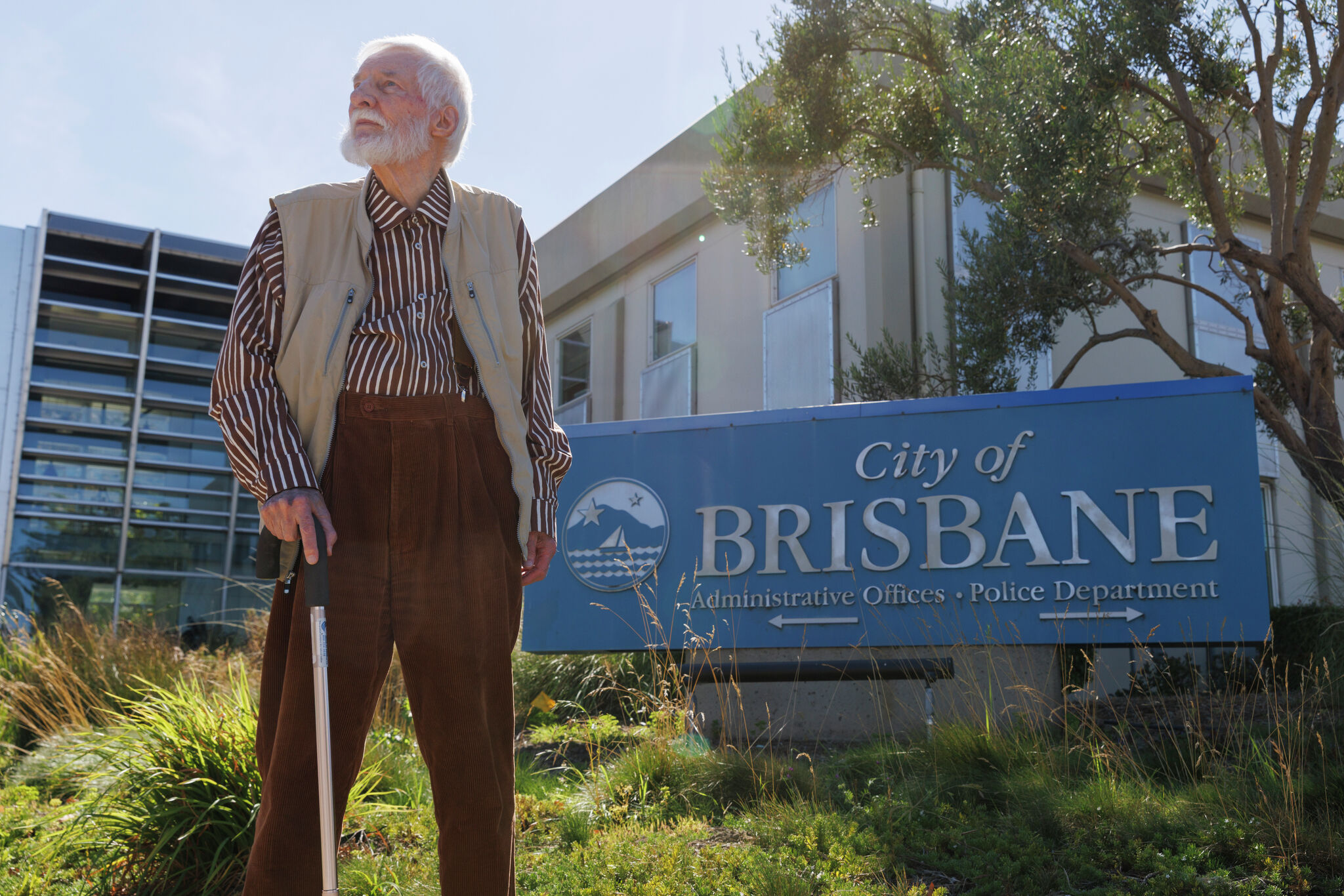
Brisbane is next to SF. This area is a former industrial site but people in the City, led by the now 91 year old former Mayor, have been fighting tooth and nail against building housing here for decades because they don't want their City to change.
It's the ultimate fvck you I've got mine attitude and a prime example of why housing is so expensive in California. Wonder how much racism is playing a role in this.
A suburb bordering S.F. lost control over housing development. What happens next?
A couple of decades from now, if developers have their way, Caltrain riders leaving Bayshore station will look out over a
new carbon-neutral neighborhood of apartment buildings, tree-lined streets and plazas. But as former Brisbane Mayor Ray Miller clutched his cane at that little-used stop on a recent afternoon, he was pleased to see only towering weeds, rusting fences and a grassy mound where one of the Bay Area’s largest garbage dumps once sat.
“What makes me angry,” he said, “is thinking about what this place might become.”
Miller, 91, is hardly alone. For the past 21 years, he and many other Brisbane residents have opposed efforts to transform the roughly 680-acre former industrial site straddling the San Francisco border into a mixed-use development with thousands of homes. They fear the proposed Baylands project, which could more than double the population of their hillside suburb, would threaten
Brisbane’s small-town character while posing serious long-term environmental and health risks.
Yet as California’s housing crisis has worsened, state officials have become less willing to accept those concerns as justification for blocking more homes. In July, after Brisbane repeatedly missed deadlines to approve a plan for up to 2,200 homes on the Baylands site that would cover 81% of its state-mandated housing allocation, California
ruled the city out of compliance with state housing laws.
That puts Brisbane at risk of civil penalties,
a lawsuit or the loss of state funding if it doesn’t adopt the plan. Now, as housing advocates wait to see what Brisbane does next, this community of 4,700 residents just south of San Francisco finds itself at the center of a heated statewide debate: Can California’s
increasingly aggressive enforcement of housing laws accomplish what years of planning mandates couldn’t?
“It’s pretty ironic when you think about it,” said Jeremy Levine, policy manager for the Housing Leadership Council of San Mateo County, which has worked to educate Brisbane residents on the Baylands project. “This community was so determined to protect what makes it special that it actually ended up with less control over its future.”
Most California cities are
well behind on their state-mandated housing targets. But of the dozen or so that the state has deemed noncompliant, none matters more to the
Bay Area housing shortage than Brisbane. The Baylands site, with its sprawling acreage near Highway 101, public transit and major employment centers in San Francisco and Silicon Valley, could make a significant dent in one of the nation’s most severe regional
job-housing imbalances.
Pressure has been building in Brisbane, where the median home sale price more than doubled to $1.3 million in 2022 from $597,500 in 2012, according to the city’s housing plan. For young people who grew up here, the prospect of staying — or coming back — can feel out of reach.
“I think I’m going to pursue a career in tech sales, just because I hope to afford a house in my hometown someday,” said Sebastian Bousquet, an 18-year-old Brisbane native now attending the University of San Diego. “I want to have a family, and give my kids a childhood like the one I had, which will probably cost a lot of money.”
Nearly eight years after Brisbane voters approved housing plans for the Baylands site, city leaders have yet to adopt the zoning needed to build them. The city’s Planning Commission voted unanimously last month to recommend the City Council finally adopt the plan. Last Thursday, the council scheduled a final vote in October, setting up a test of whether California can compel local officials to approve housing.
“What’s happening in Brisbane really is a fascinating case study for this new approach the state has taken with its housing laws,” said Christopher Elmendorf, a law professor at UC Davis who’s a leading authority on California housing law. “A lot of eyes will be on those city council meetings.”
Brisbane has long attracted outsize attention on housing-related issues. For decades, developers have eyed the Baylands’ vast expanse of dry grass, weeds, dirt and gravel for its real estate potential.
The official
Baylands development website reads like an urbanist fever dream for sustainable living: A massive solar farm. An on-site fleet of electric cars for residents. Zero carbon footprint. But to many current Brisbane residents, those renderings of futuristic streetscapes might feel borderline delusional.
The Baylands site was once where San Francisco dumped its garbage and Southern Pacific railroad repaired its trains. Cleaning up the lingering contamination will likely require at least hundreds of millions of dollars and three years of soil work.
“The whole thing is just ridiculous,” said Miller, a retired San Francisco State professor with a white beard. “They used to burn tires over there. You don’t mess with that.”
Miller and his wife, Anja, bought their yellow two-story house in Brisbane for $25,000 in 1967, the same year the landfill closed. They grew to love their small town, which owes its
“City of Stars” nickname to an annual holiday ritual in which locals hang huge illuminated stars on their homes. At a downtown park, fire hydrants are painted in bright colors, then later retired to the town’s tiny hydrant graveyard.
The couple entered local politics, each serving on city council and as mayor. Miller was on the City Council in 1980 when, after years of fighting a massive development project on San Bruno Mountain, the city helped convince the federal government to declare the mountain critical habitat for the endangered callippe silverspot butterfly. Nine years later, as mayor, he helped negotiate a settlement with a developer — who sued him personally — to scale back another proposed development on the mountain.
But nothing could prepare Brisbane for the battle over the Baylands.
The saga began in 2004, when development group Universal Paragon Corp. applied to build 1 million square feet of commercial and retail space on the old landfill. The proposal called for shopping centers, offices, auto dealerships and hotels — but not housing, which the developer said was incompatible with the site’s contamination.
The plan evolved over the years as environmental studies and cleanup proposals developed, and demand for housing grew. By 2010, the proposal called for about 4,400 homes, mostly concentrated in the northwest corner of the Baylands site, away from the old landfill.
As neighbors aired their opposition to the project, housing activists cast Brisbane as a poster child for the NIMBY movement. Early in the city’s negotiations with Baylands developers, for example, a City Council member had even suggested skirting a state law that requires cities to plan for new housing — by zoning for homes at the bottom of the Brisbane lagoon.
In 2016, the City Council was still pushing for a Baylands plan devoted entirely to retail when a quote from Mayor Cliff Lentz published in the Chronicle
went viral: “We’ll provide the commercial — S.F. will provide the housing.” To pro-housing activists, the quip captured their mounting frustration with the limits of local control over sprawling housing projects.
Proposition 13 — the 1978 California law that caps property-tax rates and limits increases in assessed property value — created a powerful incentive for cities to favor commercial development over housing. And that’s not even accounting for what author Jennifer Mapes, who has written extensively about small-town development, calls the “charm factor.”
Brisbane residents take immense pride in their 3-square-mile community’s slightly eclectic, self-contained civic culture. “In a place like that, tradition really matters,” Mapes said. “When faced with the prospect of such expansive growth, it’s almost natural for people to kind of freak out.”
In late 2017, desperate to push the project forward after more than a decade with minimal progress, the California legislature threatened to strip Brisbane of its control over the Baylands if it didn’t approve thousands of homes. Left with little choice, the City Council introduced a ballot measure that offered a compromise: 2,200 housing units.
It narrowly passed in November 2018.
“I felt like a gun was held to our heads,” then-Mayor Clarke Conway recently recalled.
But Anthony Walker, chair of Brisbane’s Open Space & Ecology Committee, points out that the project is far from the older cottages and modest apartment buildings that line Brisbane’s quaint downtown. Bounded by Highway 101 to the east, and Bayshore Boulevard to the west and south, the Baylands would feel like its own district.
“It’s possible for us to have the best of both worlds,” Walker said. “We can have modern conveniences while still holding onto what makes Brisbane special.”
In recent years, as some Brisbane residents continued to voice concerns about town character and environmental contamination, Baylands supporters often heard little more than delay tactics.
Jonathan Scharfman, who served as general manager for the development group behind the Baylands from 2005 to 2019, notes that San Francisco’s Mission Bay was also once an old rail yard requiring extensive cleanup. Today, it’s a
fast-rising neighborhood of life-science campuses, office space, retail and housing.
“The Baylands will have the opportunity to grow thoughtfully,” Scharfman said. “People need to keep in mind that all of this will occur gradually over many years.”
After decades fighting development, can state enforcement force through housing proposals in the Bay Area city?

www.sfchronicle.com